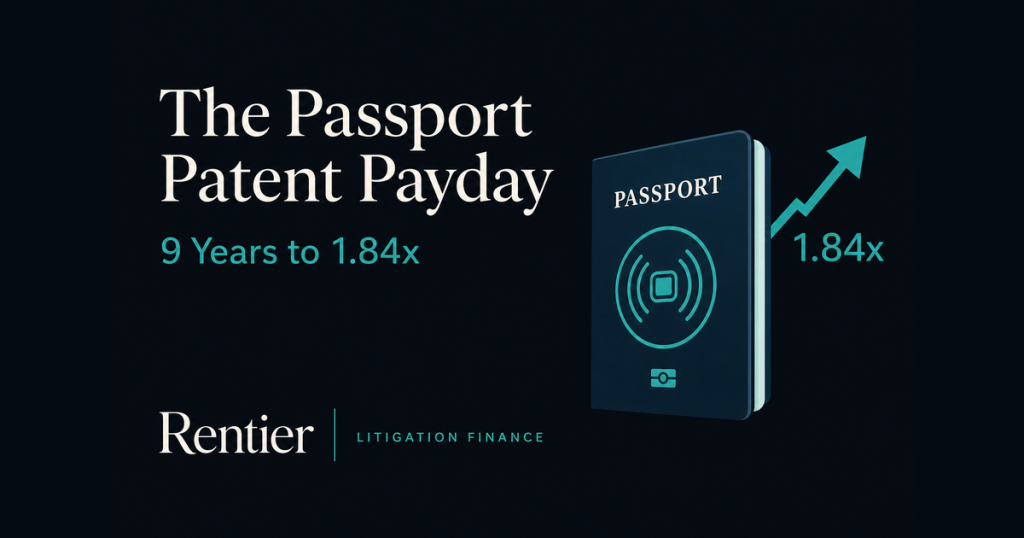
LexShares Case #644: The Passport Patent Payday
An inventor’s RFID technology ended up in every US electronic passport. After 9 years of litigation, the government finally paid.
The Numbers
| Invested | $25,000 |
| Returned | $45,897 |
| Net Profit | $20,897 |
| MOIC | 1.84x |
| IRR | 9.43% |
| Holding Period | 2,458 days |
The Case
In the mid-2000s, an inventor developed technology for securely scanning electronic passports — RFID shielding, electronically switchable tags, and methods for reading passport chips while protecting them from unauthorized access. He filed four patents covering different aspects of the technology.
Then he discovered the US Government was using it — in every electronic passport.
Modern US passports contain an RFID chip storing the holder’s information. The chip uses “Basic Access Control” to prevent skimming and eavesdropping. The inventor’s patents covered key elements of this system.
The government had deployed this technology at airports and border crossings nationwide. Tens of millions of passports issued every year, each one potentially using his patented technology.
The math: 12-19 million passports issued annually at $110 each. Even a 0.5% royalty would yield $50 million+ over the infringement period.
In December 2016, the inventor and his company filed suit in the US Court of Federal Claims against the United States and multiple government contractors — a major IT company, a French tech conglomerate, and an identity security firm spun off from it.
Timeline
| Date | Event |
|---|---|
| Dec 2016 | Complaint filed |
| Aug 2017 | First contractor intervenes |
| Feb 2018 | Motion to dismiss denied |
| Aug 2018 | Favorable Markman order; IPR deadline passes with no challenges |
| 2018 | First contractor settles (confidential) |
| Apr 2019 | My investment — $25,000 |
| Oct 2019 | Second contractor intervenes |
| Feb 2020 | Third contractor intervenes; judge recused |
| 2020-2023 | Discovery, stays, procedural battles |
| Sept 2024 | Mediation — no settlement |
| Dec 2024 | Government accepts settlement offer |
| July 2025 | Contractors accept settlement terms |
| Sept 25, 2025 | Judgment entered |
| Jan 9, 2026 | Distribution received — case closed |
The Settlement
Total settlement: $6,750,000 — split between the US Government ($5.5M), and two contractors ($1M and $250K). The fund’s recovery came from the government portion.
In exchange, the plaintiff granted a worldwide perpetual license and covenant not to sue. All claims dismissed with prejudice.
Why the Settlement Was Lower Than Claimed
Original claimed damages: $60M+. Actual settlement: $6.75M — about 11% of the claim.
| Factor | Impact |
|---|---|
| Royalty rate optimism | 0.5% × millions of passports sounds good on paper, harder to prove at trial |
| Government defendant | Sovereign immunity considerations; governments rarely pay full freight |
| Litigation fatigue | After 9 years, both sides wanted certainty over continued fighting |
Patent damages are theoretical until proven. The question is whether the settlement still produces good returns — and 2.2x gross does.
The Returns
| Metric | Fund | My Share (1%) |
|---|---|---|
| Investment | $2,500,000 | $25,000 |
| Recovery (gross) | $5,500,000 | $54,854 |
| Expenses | ($14,647) | — |
| Carried interest (30%) | — | ($8,956) |
| Net return | $5,485,353 | $45,897 |
| MOIC | 2.20x | 1.84x |
What Went Right
Strong patents that survived scrutiny. No Inter Partes Review petitions filed. Favorable Markman ruling on claim construction. When defendants don’t challenge validity, they’re conceding the patents are real.
Deep-pocket defendants. The US Government and major contractors aren’t judgment-proof. Collection was never a concern.
Experienced IP counsel. A Silicon Valley boutique with 24 lawyers who knew how to litigate patent cases against the government — not a solo practitioner who could get overwhelmed.
What I Learned
Government cases take forever but eventually pay. December 2016 to January 2026 — nearly a decade. Multiple judges, contractor interventions, COVID delays, failed mediation. But when judgment was entered, the money came.
Claimed damages are marketing. “$60M+ claimed” sounds exciting. “$6.75M actual” is what you get. A 90% haircut from claim to settlement is common. The question is whether the settlement still produces good returns.
2.2x gross becomes 1.84x net. The 30% carry on profits takes a real bite. Still solid, but the spread matters when evaluating opportunities.
~9.5% IRR over nearly 7 years is respectable. Not the 25%+ projected in marketing materials, but competitive with public equities for the period. Litigation finance is an alternative asset class with lumpy, uncorrelated returns — not a get-rich-quick scheme.
This was my 15th LexShares investment and one of my best outcomes. An inventor proved the US Government was using his passport technology without a license. My $25,000 became $45,897 — an 84% profit over nearly 7 years. Not the 3x originally projected, but a genuine win in a space where total losses happen regularly. Sometimes the system works.
Commentary and personal experience — not investment, legal, or tax advice. Investing carries risk, including total loss of capital. Always do your own due diligence.