
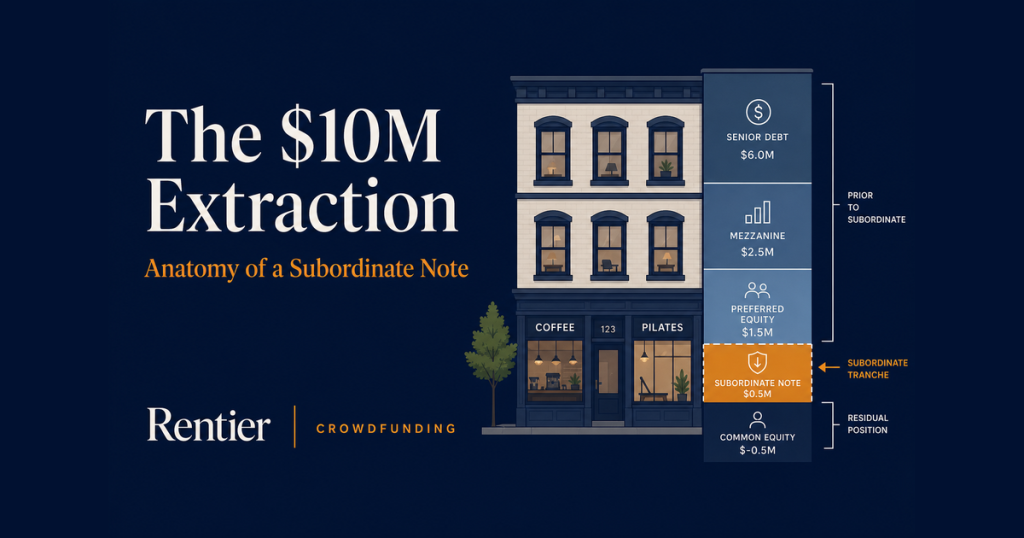
The $10M Extraction: Anatomy of a Subordinate Note
What a 27-page Series Note Supplement reveals about a real estate deal that the marketing page doesn’t
A word on why I read 27 pages of a note supplement most investors will never open. Willow Wealth is the company formerly known as YieldStreet — the platform where I committed $250,000 to a “senior secured” law-firm loan and walked away with $162,258. That $87,742 loss taught me one lesson I won’t unlearn: on these platforms, the label on a deal (“senior,” “secured,” “diversified”) tells you almost nothing about the risk inside it. So when the rebranded version of the platform that burned me put out a new offering, the marketing page wasn’t where I looked.
The Deal
Willow Wealth launched a new real estate debt offering in April 2026: Santa Monica Mixed-Use Financing. It’s a participation in a $42 million first mortgage loan on a mixed-use property at 2300 Wilshire Boulevard in Santa Monica, California.
The marketing page promises an 11.5% net annualized yield, monthly interest distributions, a 19-month target term, and a 35% equity cushion. The property is described as a “recently built, three-story residential and retail property” anchored by “a national grocery chain voted #1 in the United States in 2026.”
I read the 27-page Series Note Supplement, the PPM, and the Indenture. Here’s what the marketing page leaves out.
The Property and the Borrower
The offering page doesn’t name the property, the borrower, or the sponsor. The Series Note Supplement describes the Sponsor only as “a vertically integrated real estate development and operating company headquartered in Hong Kong and publicly listed on the Hong Kong Stock Exchange, with an operational footprint spanning China, the United States, and the United Kingdom.”
This is permitted—the Private Placement Memorandum explicitly states: “The Company reserves the right, in its sole discretion, to not disclose the name or identity of any borrower, guarantor, sponsor, obligor, originator, manager, member, principal or other party related to the applicable Investment.”
But public records and a November 2025 Commercial Observer article make identification straightforward:
- Property: 2300 Wilshire Boulevard, Santa Monica, CA
- Borrower: GR Properties USA, a subsidiary of GR Life Style Co. Ltd. (HKEX: 0108)
- Grocery anchor: Trader Joe’s (voted #1 by ACSI in 2026)
- Originator: Castellan Real Estate Partners (also known as Castellan Capital)
The Supplement also references the Sponsor owning “a 139-unit multifamily property in Culver City, California”—consistent with GR Properties’ known Culver City development.
GR Life Style’s Financial Condition
GR Life Style is publicly listed, so its financials are available. For the year ended December 31, 2025:
| Metric | FY2025 | FY2024 |
|---|---|---|
| Revenue | HK$327.9M | HK$310.0M |
| Net Loss | (HK$109.6M) | (HK$918.5M) |
| Finance Costs | HK$153.1M | — |
| Interest Coverage | 0.7x | — |
| Debt-to-Equity | ~130% | — |
Sources: MarketScreener, TipRanks, Simply Wall St
The FY2024 loss of HK$918.5M was driven primarily by fair-value write-downs on Chinese properties. The FY2025 loss narrowed substantially, but the company remains unprofitable, with finance costs (HK$153M) consuming nearly half its revenue and interest coverage below 1x.
The Series Note Supplement discloses the guarantor’s position as of December 31, 2024: $54.5 million in net equity and $5.0 million in cash liquidity. For a guarantor backing a $42 million loan, $5M in available cash is thin.
The Capital Structure
This is where the offering gets interesting. The marketing page describes a “loan secured by a mixed-use property” with a “65% loan-to-value ratio.” But the actual capital structure has multiple layers that investors need to understand.
The Underlying Loan: $42M
| Tranche | Amount | % of Loan | Holder |
|---|---|---|---|
| Senior Note | $29,400,000 | 70.0% | Federally chartered savings bank |
| Subordinate Note — Willow Wealth | $10,000,000 | 23.8% | WW CSTN REL II LLC (retail investors) |
| Subordinate Note — Originator | $2,600,000 | 6.2% | Castellan Real Estate Partners |
The retail investor piece is the subordinate note—the first-loss position. In a default, the senior note holder (a bank) gets paid first. Subordinate note holders absorb losses after the bank is made whole.
The Chain Between You and the Property
The investment structure has four layers of intermediation:
- Investor purchases a Borrower Payment Dependent Note from YS ALTNOTES II LLC (the Issuer)
- YS ALTNOTES II LLC owns the membership interests of WW CSTN REL II LLC (the SPV)
- WW CSTN REL II LLC holds a 79.4% participation interest in the Subordinate Note
- The Subordinate Note sits behind a $29.4M Senior Note in the $42M first mortgage on the property
Your note is borrower-payment-dependent, meaning you only get paid if the borrower pays. No guarantees from Willow Wealth, Castellan, or anyone else.
The Sources and Uses: Follow the Money
The Series Note Supplement includes a sources-and-uses table. This is where the deal economics become clear:
| Sources | $ | Uses | $ | % |
|---|---|---|---|---|
| Senior Note | $29,400,000 | Loan Payoff | $30,266,186 | 72.1% |
| Subordinate Note (WW) | $10,000,000 | Property Tax Payment | $479,196 | 1.1% |
| Subordinate Note (Castellan) | $2,600,000 | Fees and Closing Costs | $1,265,174 | 3.0% |
| Cash Out to Sponsor | $9,989,444 | 23.8% | ||
| Total | $42,000,000 | Total | $42,000,000 | 100% |
Nearly $10 million—24% of the entire loan—goes directly to the sponsor as a cash-out. The existing debt payoff is $30.3M. The sponsor is extracting equity at the same time retail investors are being asked to fund the riskier subordinate tranche.
To restate: the sponsor takes $10M off the table, while investors take $10M of first-loss risk. That’s not alignment—it’s extraction.
The Senior Note: What Happens in a Default
The marketing page describes a “35% equity cushion.” What it doesn’t mention is the cure rights embedded in the Senior Note agreement:
In the event the Underlying Loan becomes 90 or more days delinquent or enters any default, the Senior Note requires a 10% principal paydown within 30 days of such delinquency or default, and full repayment of the outstanding Senior Note balance within 90 days, which payments shall be required to be made by the holders of the Subordinate Note (including the WW SPV).
Translation: if the loan goes delinquent, the subordinate note holders (including Willow Wealth investors) must pay down the senior note—up to the full $29.4M balance—within 90 days. This isn’t a theoretical risk; it’s a contractual obligation that accelerates losses for the junior tranche.
In addition, Castellan has provided a full recourse guaranty on the Senior Note. That protects the bank. Nobody has guaranteed the subordinate piece.
Leverage on Leverage
The Series Note Supplement discloses that WW SPV itself “expects to employ leverage to make the Investment and may, in the future, incur additional indebtedness.” This means the SPV is borrowing to fund the participation purchase. The leverage provider gets a first priority security interest on WW SPV’s assets—ahead of investors.
The risk factors spell out the consequences explicitly:
Prospective investors should understand that the result of such a sale could be the complete loss of the value of the Investments and, as a result, the value of the Notes.
There’s also a cross-default provision: the leverage facility includes terms tied to other funds managed by Willow Wealth. A failure elsewhere in Willow Wealth’s portfolio—completely unrelated to this property—could trigger a default that gives the leverage provider the right to remove the manager and force-sell the investment at a loss.
The Business Plan Risk
Repayment depends on selling 30 residential condos and the retail component. As of the offering date:
- The sponsor has received approval to market the units but not to close sales. Final approval is expected in Q2 2026 but is not guaranteed.
- The loan matures November 1, 2027 with no extension options.
- Residential occupancy has dropped from 97% to 83.3% as the sponsor intentionally does not renew leases in anticipation of the condo conversion.
- The minimum release price of $856 PSF is below the appraised value of $1,245 PSF, providing a margin for price softening—but any delay, regulatory hold, or market downturn compresses the timeline to maturity.
The property was originally built as a condo project in 2019. The sponsor pivoted to rentals when the condo market softened, took out a ~$30M mortgage, and is now pivoting back to condos while cashing out $10M. That’s two business plan changes and an equity extraction in six years.
The Fee Stack
Before an investor earns anything, the following comes off the top:
| Fee | Amount | Paid By |
|---|---|---|
| Commitment Fee (one-time) | 1.00% | Investor (deducted from invested capital) |
| Management Fee (annual) | 1.50% | WW SPV |
| Servicing Fee (annual) | 1.00% | WW SPV (paid to Castellan) |
| Access Fee (annual) | 0.25% | Allocated to investors (per Indenture) |
| Structuring Fee | $100,000 | Originator pays to Willow Wealth |
The 1% commitment fee is particularly notable. If you invest $10,000, only $9,900 actually purchases notes. Combined with the 1.50% management fee, 1.00% servicing fee, and other expenses, the gross-to-net drag is substantial on a 19-month investment.
What the Marketing Page Says vs. What the Documents Say
| Marketing Page | Offering Documents |
|---|---|
| “Participation in a loan secured by a mixed-use property” | Participation in the subordinate piece of a loan—behind a $29.4M senior note from a bank |
| “35% implied equity cushion” | The cushion protects the whole loan. The subordinate piece is first-loss, and cure rights can force subordinate holders to pay down the senior note within 90 days of default |
| “Repeat originator with vested interest” | Castellan retains $2.6M (21%) of the sub note. Investors take $10M (79%). Castellan guaranteed the senior note—not the subordinate piece investors are buying |
| “Modern property anchored by major grocery store” | Borrower is a loss-making Hong Kong real estate company (GR Life Style, HKEX: 0108) with $5M cash, 0.7x interest coverage, and ~130% debt-to-equity |
| “Potential downside protection” | $10M of the $42M loan was cashed out to the sponsor. The SPV itself uses leverage with cross-default provisions tied to other Willow Wealth funds |
| “84% performing in line with expectations” | Across all matured real estate debt since 2015. Nine of thirty RE deals reviewed by CNBC are in default |
Bottom Line
This isn’t necessarily a bad property. 2300 Wilshire is a real building in a desirable location, anchored by Trader Joe’s, with condo comps that support the valuation. The Santa Monica retail market is tight. The minimum release prices are below appraised values.
But the investment structure is where the risk lives. You’re not buying a loan secured by Santa Monica real estate. You’re buying a borrower-payment-dependent note, issued by an SPV, that holds a participation in the subordinate piece of a loan, behind a senior bank note with aggressive cure rights, on a property owned by a loss-making Hong Kong parent company that just cashed out $10M of equity—the exact same amount retail investors are being asked to fund.
The 11.5% yield compensates for those layers of subordination and structural risk. Whether it compensates enough is a different question.
If the condos sell on schedule and the retail holds, investors get their 11.5% and principal back over 19 months. If there’s a delay, a price correction, a regulatory hold, or any disruption to the condo conversion timeline—with no extension options and a hard maturity in November 2027—the subordinate piece absorbs it first.
For me, it isn’t close. I already learned what a Willow Wealth label is worth the expensive way, and this structure stacks first-loss subordination, cure rights that could force me to pay down the bank, SPV-level leverage with cross-defaults tied to unrelated funds, and a sponsor cashing out the same $10M retail investors are being asked to put in. An 11.5% coupon isn’t payment for all of that — it’s the consolation prize for sitting at the bottom of a stack whose floor I can’t see. I’m passing. But that’s my risk tolerance and my scar tissue talking, not a universal verdict — so don’t take my word for it.
Read the supplement.
Sources
- Castellan Capital Loans $42M to Refi Santa Monica Mixed-Use Complex — Commercial Observer, November 2025
- GR Life Style Narrows Loss in 2025 — MarketScreener
- GR Life Style Narrows Annual Loss Despite Higher Costs and Finance Charges — TipRanks
- GR Life Style Financial Health — Simply Wall St
- Trader Joe’s Ranks No. 1 in Grocery Survey — ACSI 2026
- YS ALTNOTES II LLC — Series Note Supplement, Borrower Payment Dependent Notes Series No. YS CSTN REL II (March 25, 2026)
- YS ALTNOTES II LLC — Confidential Amended and Restated Private Placement Memorandum (November 17, 2025)
- YS ALTNOTES II LLC — Fourth Amended and Restated Borrower Payment Dependent Notes Indenture (December 29, 2022)
Commentary and personal experience — not investment, legal, or tax advice. Investing carries risk, including total loss of capital. Always do your own due diligence.

Amazing write up on this. Do you mind if I share this?
Thanks, Justin! Glad it was helpful. Feel free to share — all my posts here are free to share anywhere, no permission needed. A link back is appreciated but not required.