YieldStreet → Willow Wealth: Anatomy of a Rebrand
When $208 million in losses meets a name change — what veteran investors learned about “democratizing” alternative investments
I’m not writing this as an outside observer: I was a YieldStreet investor, and I came out behind. Across my three YieldStreet notes, two individually paid — a pre-settlement portfolio that repaid at ~13% and a small-business note that returned 1.24x — but the third, a “senior secured” law-firm loan, defaulted and cost me $87,723, more than erasing both winners. Net of everything I lost money on YieldStreet, I don’t invest with them anymore, and I don’t recommend them. I did sidestep the real-estate and marine deals behind these headlines — less foresight than luck, since real estate was never my lane.
That’s exactly why the $208M is worth dissecting rather than just dunking on. Even in my own case the problem wasn’t that every deal failed — two of three paid — it’s that one default outweighed the wins, on a platform that scaled marketing faster than underwriting, with the damage concentrated where the underwriting was thinnest. Here’s the anatomy.
What Was YieldStreet?
Founded in 2015 by Michael Weisz and Milind Mehere, YieldStreet positioned itself as a fintech platform that would “democratize access to alternative investments” — letting retail investors access asset classes like real estate, litigation finance, art, and marine shipping that were traditionally reserved for institutions and ultra-high-net-worth families.
The pitch was compelling: earn 9-15% annual returns on deals the 1% had been keeping to themselves. Backed by prominent venture firms and powered by aggressive online marketing (including Facebook ads), deals sold out in seconds or minutes. At its peak, YieldStreet was the best-known startup in the retail alternative investment space.
Then the defaults started.
The Numbers That Matter
| Performance | |
|---|---|
| Total Known Losses | $208+ million |
| Real Estate Failure Rate | 30% |
| ↳ Industry Norm | 2-8% |
| RE Annualized Returns (2025) | -2% |
| ↳ Two years prior | 9.4% |
| Investor Disapproval Rate | 73% |
| Fees | |
|---|---|
| YS Fee on RE Deals | ~2%/year |
| New Products Fee (YS layer) | ~1.4%/year |
| All-in Annual Fees (w/ underlying) | 3.3% – 6.7% |
One caveat on the headline number, because I’d want it applied to my own figures: the 30% is nine defaults across the thirty real-estate deals CNBC reviewed, not a census of everything YieldStreet ever originated. A reporter’s sample is not a portfolio, and journalists do not pick deals at random.
The number that survives that objection is a different one. Of those same thirty deals, twenty-three sat on an internal watchlist that investors were never shown. That figure doesn’t depend on how the sample was drawn, because it isn’t a claim about outcomes — it’s a claim about what the platform knew and when. Nine deals going bad can be a market. Twenty-three deals flagged internally and disclosed to no one is a policy.
The Rebrand Playbook
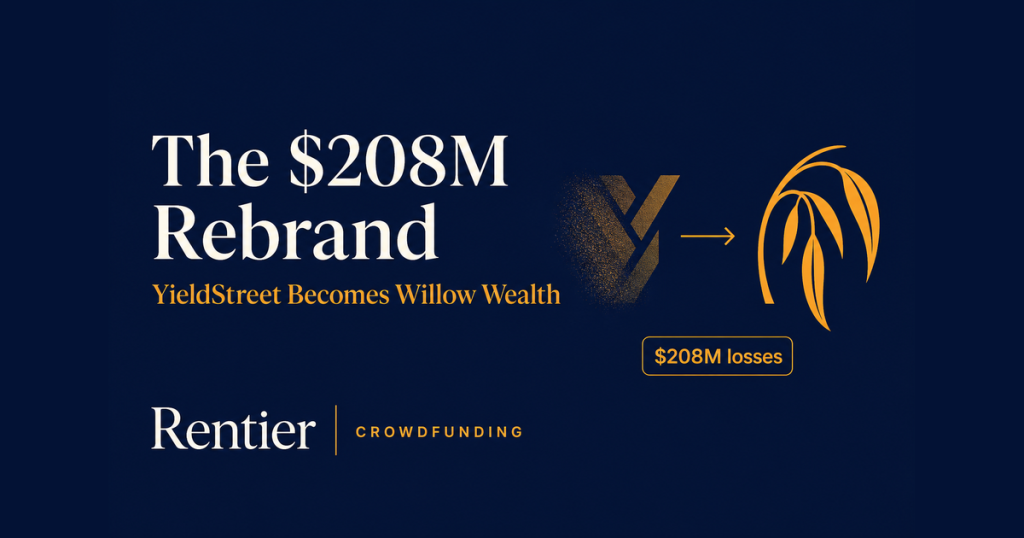
On October 22, 2025, YieldStreet became Willow Wealth, with the brand transition completed that December alongside the announcement of a new third-party fund menu. The timing was not coincidental:
| Date | Losses | Event |
|---|---|---|
| Aug 2025 | $78M | CNBC exposé on real estate losses |
| Sep 2025 | $89M | Marine loan wipeouts disclosed |
| Oct 22, 2025 | — | Rebrand to “Willow Wealth” takes effect |
| Dec 2025 | $41M | Houston & Nashville RE defaults disclosed |
| Dec 2025 | $208M+ | Cumulative losses disclosed |
| Dec 2025 | — | Decade of performance data removed from website |
The pattern is familiar: when your brand is toxic, change the name and hope everyone forgets.
Mark Williams, a Boston University professor and former Federal Reserve bank examiner, told CNBC: “Their old name had negative value to it, so they’re trying to do a 2.0 to restart things. They’re also making it harder to uncover their poor performance by removing the stats, which is alarming.”
Williams also characterized the platform bluntly: “They claimed they were going to democratize access to the types of deals only the rich had. In reality, they created a high-risk trap for investors.”
The Transparency Problem
In December 2025, Willow Wealth quietly removed a decade of historical performance data from public view — while simultaneously claiming that “transparency is paramount.”
What disappeared:
- Historical returns data showing -2% annualized RE returns (down from 9.4% two years prior)
- Deal-level performance information on troubled offerings
- The track record that would help new investors understand the platform’s full history
What they added:
- A new mascot called “Hampton Dumpty” — a play on Humpty Dumpty — who tells investors he’s “learned a thing or two about crashes” and uses Willow Wealth to diversify his portfolio
- A new CEO: Mitch Caplan, former E-Trade chief, who took the helm in May 2025
- A pivot to third-party managed funds from Goldman Sachs, Carlyle, and StepStone
- Disabled comments on YouTube ads and Instagram posts
The company claims it removed historical performance because of the pivot to third-party funds. But the timing — amid $208M in disclosed losses — raises questions.
One industry observer compared it to “rolling back the odometer before selling the car — the mileage is still there, even if it’s no longer shown on the dashboard.”
The Money Behind the New Name
The odometer line is satisfying, and it’s also slightly too small a charge. A rebrand is a marketing decision. What happened at YieldStreet in 2025 was a balance-sheet decision that a marketing decision was wrapped around, and the sequence is worth laying out because it changes what the new name means.
In May 2025, Mitchell Caplan was installed as chief executive. One month later, a $122 million Series D began closing in two tranches, led by Tarsadia Investments — where Caplan is president. So the firm writing the check and the firm receiving it were represented by the same person on both sides of the table. That is not, by itself, scandalous; investor-installed management is standard practice when a company is in trouble. But it tells you which situation you’re in. Lead investors take board seats in healthy rounds. They take the CEO’s chair in restructurings.
Two more details point the same direction. The round was funded largely by existing backers adding to positions they already held, which is what defensive capital looks like. And no valuation was disclosed — where the 2021 Series C had been openly marked at roughly $1 billion. Companies announce up rounds. Silence on price is not proof of a markdown, but it is the only circumstance in which silence is the preferred option.
Read together, the picture is not a company changing its name to escape bad press. It is a company being recapitalized by its own investors, handed to their operator, and pointed at a different business model — with the name change as the consumer-facing layer of that. Which raises the harder question: if the pivot is real, does the criticism still land?
The 2025 Defaults: Specific Deals
CNBC reporting revealed the specific deals behind the $208M+ in losses:
| Deal | Amount | Outcome |
|---|---|---|
| Stacks on Main (Nashville) | $20.2M | 268-unit luxury apartments. Full equity loss. Member loan investors lose up to 60%. Target was 16.4% annual return. |
| 2010 West End Ave (Nashville) | $35M | Full loss across two funds. Same sponsor as Stacks on Main. |
| Houston Multi-Family Equity | $21M | Suburban Texas apartments. Full loss of equity. Foreclosed — couldn’t cover debt service. |
| Portland Multifamily (Oregon) | $11.6M | Currently in default. Appraisal shows borrower owes more than property is worth. |
| Tucson Apartments + Southern SFR | $63M+ | Warned of future losses. Amount of losses unspecified. |
| Marine Finance | $89M | Wiped out (Sep 2025). SEC had fined YS $1.9M for failure to disclose risks. |
The Adam Neumann Connection
Two of the failed Nashville deals — Stacks on Main and 2010 West End Ave — were sponsored by Nazare Capital, the family office of former WeWork CEO Adam Neumann.
According to CNBC: Nazare purchased Stacks on Main in July 2021 for $79 million, then offloaded a majority stake to YieldStreet members through a joint venture. Crucially, the transaction saddled the joint venture with $62.1 million in debt — a burden that proved instrumental in the deal’s failure.
A spokeswoman for Neumann told CNBC: “This building was majority-owned by YieldStreet and the property was never operated either by Flow or anyone associated with Adam.”
Historical Track Record: Earlier Defaults
Long before the 2025 losses made headlines, investors had been tracking troubled deals:
Ridesharing Fleet Expansion
In default for 2+ years. Borrower stopped payments 12 months in. Despite “senior position,” repossession proved expensive to litigate. Marketing claimed “anticipated vehicle auction values greater than the outstanding loan at all times.”
Law Firm Financing
Multiple deals defaulted. Pitched as “nationally recognized law firm” with 31,000 cases — later revealed many were not “full-fledged finally accepted cases.” Law firms disputed contract terms.
Commercial RE Portfolios
Multiple missed balloon payments. Single tenant retail properties where tenants filed for bankruptcy. Interest-only payments in lieu of principal return.
Multi-Use RE Portfolios
Multiple loans in delinquency across portfolio. Maturity dates missed.
Louisiana Oil & Gas
Borrower violated covenant test. Platform initiated foreclosure.
Pre-Settlement Portfolios
Multiple deals showing “ongoing” status years past maturity — amounts repaid far below expectations.
Regulatory History & Lawsuits
Both of the formal proceedings against YieldStreet concern the marine book, and both were resolved before the real-estate losses surfaced:
| SEC settlement (Sep 12, 2023) | $1.9M | $1.0M civil penalty, $896,450 disgorgement, ~$50,000 prejudgment interest. The finding: YieldStreet marketed a 2019 vessel-deconstruction offering while holding information that ships pledged as collateral in related deals had already been scrapped. No admission or denial. |
| Class action Tecku v. YieldStreet S.D.N.Y. 1:20-cv-07327 |
$9M nominal ~3¢ realized |
Filed Sep 2020, final judgment Feb 21, 2025. The $9M headline is $6.2M cash plus $2.75M in waived fees; roughly $2.3M went to plaintiffs’ counsel, leaving about $4M for some 1,200 class members — an average near $3,300 each, against marine losses of $89M. |
That last row is the one worth sitting with, because it answers a question most retail investors never ask before they wire money: what does winning look like? The Tecku class won. They got a settlement, a judge’s approval, and a recovery of roughly three cents on each dollar the class had put in — and the fee-waiver component of that $9M headline was money the class was never going to see as cash anyway. Litigation is not a recovery strategy for a $10,000 note. It is a way to convert a total loss into a slightly smaller total loss several years later.
Why Did This Happen? The Due Diligence Gap
Feedback from veteran alternative investment communities reveals consistent patterns in YieldStreet’s approach:
Inadequate Disclosure
- No property addresses on real estate deals — impossible to verify location quality
- No portfolio breakdowns on litigation deals — unclear which cases, which have defaulted, how they’re underwritten
- Sponsor names obscured — investors “heavily — almost exclusively — reliant on YS to vouch for the quality of sponsors”
- Limited stress-test data — insufficient information to model downside scenarios
Superficial Investor Relations
- Quarterly updates as brief as “performing as expected” — no substantive detail
- IR staff lacked investment expertise — after a run of vague answers, our group looked up the rep handling our questions and found a recent graduate with no finance background. That is not her failing; nobody should be sent alone to explain a subordinated credit structure in their first year. It is a statement about how seriously the firm took the job of answering investors.
- Response times measured in days against deal windows measured in minutes — by the time an answer came back, the allocation was gone
The Black Box Problem
One longtime investor summarized it: “It’s otherwise impossible to properly vet a RE deal here. There are many other crowdfunding sites who do them better since it’s their bread and butter.”
Another noted: “YS just checks the box on the obvious things like LTV and DSCR [. . .] underwriting real estate offers is not their forte. Nor would I actually even call that underwriting.”
The “Democratization” Disconnect
YieldStreet’s core pitch was “democratizing access to investments only the rich had.” The reality:
| What Was Promised | What Actually Happened |
|---|---|
| “Access to investments of the 1%” | Institutional investors get granular data and negotiating power; retail got glossy marketing and seconds to decide |
| “Senior secured” protection | Restructured away in defaults; investors subordinated to preserve deals |
| Transparent fee structure | Performance charts exclude fee impact; benchmarks show indexes customers can’t actually invest in |
What Veteran Investors Actually Did
Among experienced alternative investment communities, patterns emerged:
Early adopters who got lucky:
- Some litigation finance deals from 2017-2018 paid as promised, in the low teens
- Deals that exited before problems emerged performed well
- Platform acquisition events created unexpected early exits
Those who stayed too long:
- 36-month deals became 6+ year nightmares
- “Senior secured” positions restructured to junior
- COVID delays compounded underlying underwriting problems
The consensus exit strategy:
- “If I could go back in time, I would avoid YS real estate deals”
- Some continued using YS for hard-to-find non-RE alternatives (litigation, marine, small business)
- Most stopped deploying new capital well before 2025 headlines
The Synapse Problem (2024)
Separate from investment performance, YieldStreet customers faced another crisis in 2024 when the banking-middleware provider Synapse collapsed — a structural failure I took apart in its own post, because it had nothing to do with underwriting and everything to do with what “FDIC-insured” actually promises:
- Wallet funds held at partner bank Lineage became inaccessible
- Funds were “fully accounted for” but frozen for months
- YieldStreet had to work with FDIC and trustees to recover customer cash
- This affected only Wallet funds, not investments — but eroded trust further
The Strongest Case for the Other Side
I’ve been hard on this platform, and I have an obvious motive, so let me put the best version of the defense in writing.
The pivot is not cosmetic. Willow Wealth’s new menu — the Carlyle Tactical Private Credit Fund, the StepStone Private Markets Fund, the Goldman Sachs Real Estate Diversified Income Fund — consists of real products run by real institutions with track records that have nothing to do with YieldStreet’s. If the diagnosis is that YieldStreet couldn’t underwrite, then getting out of underwriting is a responsive fix, not an evasion. And the transparency complaint gets weaker on this reading: a decade of performance data from a discontinued in-house origination business is genuinely less relevant to someone buying a Carlyle fund than the critics allow. It is not obviously dishonest to stop publishing the track record of a business you are exiting.
The infrastructure argument holds too. YieldStreet did bring asset classes to retail price points that were previously locked behind institutional minimums, and I used that access myself — two of my three notes paid. Building that plumbing was a real accomplishment, and it does not stop being one because the credit judgment layered on top of it was bad.
Here is where I still come out the other way. First, the fix and the disclosure are the same act, and that’s the problem: the historical record didn’t become irrelevant, it became inconvenient, and the two arrived on the same day. A company confident in the defense above could have kept the archive up under a “legacy originations” heading and lost nothing. Second, and more practically — if the product is now a Carlyle or Goldman fund, then the platform is a distribution channel, and you should price it as one. Those same funds are reachable through iCapital, CAIS, or an ordinary advisor relationship. Going through Willow Wealth means paying a fee layer for access you can get elsewhere while retaining counterparty exposure to a firm in the middle of a restructuring. The steelman establishes that the new products may be fine. It does not establish a reason to buy them here.
Lessons for Alternative Investors
YieldStreet/Willow Wealth is a cautionary tale about the “democratization” of alternative investments. The platform’s co-founder built a successful digital marketing agency — the marketing was always world-class. The underwriting was not.
- If you can’t verify, don’t invest. Obscured sponsor names and missing property addresses are disqualifying. Institutional investors demand granular data; retail platforms that don’t provide it are hiding something.
- Speed kills due diligence. Platforms where deals “sell out in seconds” are optimizing for FOMO, not informed decisions.
- “Senior secured” is marketing language. In a restructuring, seniority can be negotiated away — as YieldStreet investors learned repeatedly.
- High interest rates don’t compensate for default risk. Stacks on Main was marketed at a 16.4% annual target. Equity holders realized negative one hundred percent, and the member-loan investors sitting above them still lost up to 60%.
- Track third-party reviews, not platform marketing. Independent investor communities spotted problems years before headlines.
- Watch for the rebrand playbook. Name changes during crisis periods are not fresh starts — they’re warning signs. The losses remain, even if the website doesn’t show them.
For me the takeaway is operational, not righteous. My own YieldStreet book is effectively closed — two notes repaid, the “senior secured” one defaulted with next to nothing left to recover, and none of it was ever something I could simply unwind anyway; these notes are illiquid and resolve on their own clock. So the only live decision is whether the platform gets new money from me — and the answer is no, full stop. When the rebranded company put out a new deal, I didn’t skim the marketing page — I read all 27 pages of the note supplement and found the same gap between the label and the structure that defined the losses above. The name on the door changed. My diligence didn’t.
As of January 2026, Willow Wealth continues to operate under scrutiny. Nine of thirty real estate deals reviewed by CNBC are now in default. The rebrand hasn’t washed away $208 million in losses — and investor communities are ensuring the history follows the new name.
Update — July 2026: The Flagship Fund Is Being Sold
I wrote the above in January framing the rebrand as cover. Two months later a filing landed that reframes it as something more consequential.
On March 19, 2026, the Yieldstreet Alternative Income Fund filed a Form 425 disclosing that it is being transferred to Mount Logan Capital’s SOFIX interval fund in a tax-free reorganization. That fund — better known by its old name, the Prism Fund — held north of $147 million and was the company’s only registered investment vehicle. Existing shareholders receive SOFIX shares at net asset value, so nobody takes a mark on the exchange itself. Willow Wealth receives about $5 million for handing over the business: $2 million cash, $1 million in Mount Logan stock, and up to $2 million more over two years for transition services.
Two things about that are worth flagging.
The first is what the Prism Fund was. It was YieldStreet’s own answer to the criticism running through this entire post. Every complaint above — no sponsor names, no addresses, no portfolio breakdown, seconds to decide — was a complaint about buying single deals off a marketing page. A registered, diversified, audited, continuously offered fund was the structural response to that. Selling it is not a tidy-up of a legacy line. It is the disposal of the one product that answered the objection.
The second is that this completes the argument I made in the steelman section above, and it completes it against the platform. If the in-house origination business is winding down and the flagship registered fund is going to Mount Logan, then Willow Wealth is not an asset manager that had a bad decade. It is a storefront — a customer list and a signup flow, monetized by distributing other firms’ funds. That is a legitimate business. It is also a business with no answer to the question of why you would buy a Carlyle or Goldman product through a middleman rather than directly. The fiduciary risk of being manager-of-record has been transferred away. The fee layer has not.
I have one measurement of that fee layer from my own file, and it cuts both ways. On the law-firm loan the borrower was paying 18% and I was receiving 12.75%; the gap was a management fee to YieldStreet plus a servicing fee to the originator. The management fee was defined as a spread over LIBOR while my 12.75% was fixed, so every basis point of rate increase after 2018 accrued to the platform rather than to me. In September 2022 YieldStreet cut that fee, disclosing that the contractual variable rate “in the current interest rate environment would exceed 4%.” They volunteered that and didn’t have to, which I credit. It is also a fairly precise picture of which side of a fee layer absorbs a surprise when nobody is watching the definition.
Elsewhere in the file: marine investors have been told to expect nothing on the $89 million, and co-founder Milind Mehere has fully exited operations. Nothing in six months has changed my answer on new money. What changed is my read on the name. In January it looked like a company hoping everyone would forget. It looks more like a receipt.
Sources
- CNBC: $208 million wiped out: Yieldstreet investors rack up more losses as firm rebrands to Willow Wealth (Dec 5, 2025)
- CNBC: When ‘invest like the 1%’ fails: How Yieldstreet’s real estate bets left customers with massive losses (Aug 18, 2025)
- The Real Estate Crowdfunding Review: Rolling Back the Odometer (Dec 17, 2025)
- The Real Estate Crowdfunding Review: YieldStreet Deep-Dive Review
- Investment News: SEC hits Yieldstreet with $1.9M penalty — SEC Rel. 33-11230 (Sep 12, 2023)
- SEC EDGAR: Yieldstreet Alternative Income Fund, Form 425 (Mar 19, 2026), CIK 0001762229 — Mount Logan / SOFIX reorganization
- Tecku, et al. v. YieldStreet, Inc., S.D.N.Y. No. 1:20-cv-07327 (Marrero, J.) — final approval Feb 21, 2025
- CrowdfundedWealth: Willow Wealth 2026 Status Review — Series D structure, Mount Logan terms, settlement arithmetic
Commentary and personal experience — not investment, legal, or tax advice. Investing carries risk, including total loss of capital. Always do your own due diligence.