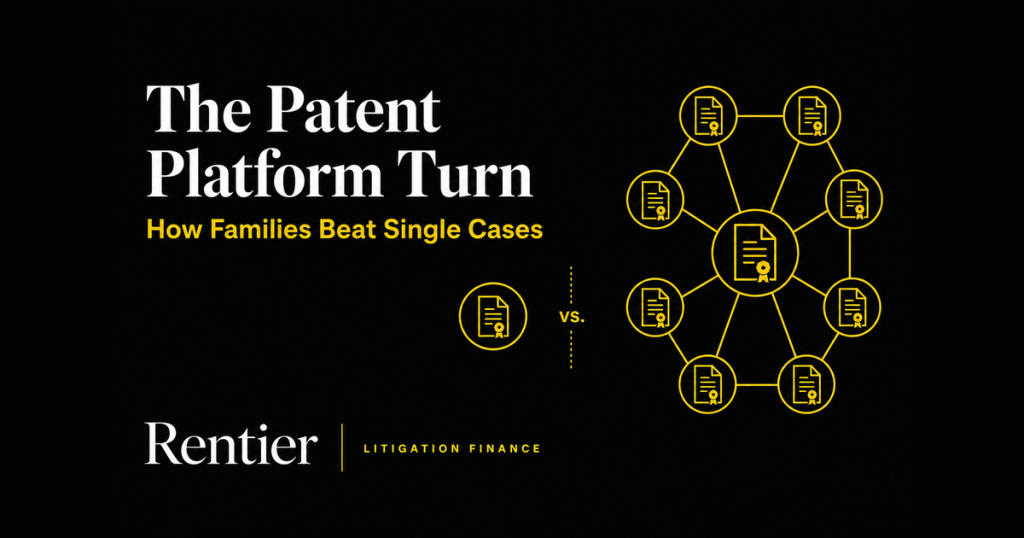
The Patent Platform Turn: How Families Beat Single Cases
Funders moved from single patents to patent families and licensing campaigns, and the strategy is genuinely better than what I bought. But when I looked for the returns, I found thin numbers — and discovered the biggest change in patent economics wasn’t strategy at all.
My interest here isn’t academic. The “old model” — one patent, one defendant, one big swing — is exactly how I bought patent cases as a retail investor on LexShares. I held a handful of single-patent bets; a couple worked (a passport-RFID case returned 1.84x over nine years), most disappointed, and the whole thing was part of a 42-case retail litigation book that finished at a 1.25% IRR. One of those patent bets still isn’t resolved: I bought in at the end of 2018, and the appeal wasn’t set for oral argument until 2026 — nearly eight years of capital tied up waiting on a single binary outcome. So when I read that sophisticated funders are moving away from single-case bets toward platforms, I don’t read it as industry trivia. I read it as a description of nearly everything my own approach got wrong: single-case concentration, no diligence budget, no way to wait out a holdout.
I wrote this up in January as a description of the strategy. I’ve since gone back to ask the question I should have asked first — does the platform model actually produce better returns, and is the strategy what’s driving them? — and what follows is the revised version. The strategy holds up. My explanation of why patent monetization got more attractive was wrong, and it was wrong in a way that matters for anyone underwriting it today.
The Through-Line: The Label Is Not the Risk
The idea this blog keeps returning to: the label on a financial product is not the risk inside it — read the structure. My tuition on that came from a loan marketed as “senior secured” against a portfolio of 22 class actions. Twenty-two sounds like diversification. Ten of them carried 94% of the collateral value, and all ten rested on the same untested legal theory — so a court rejecting that theory wouldn’t reject one case, it would reject ten at once. A count is not a portfolio. “Patent platform” is a newer and better label, because a family of related patents genuinely is a different risk than a single case. It also invites precisely that error, and the question is always whether the correlation inside the family has been priced.
Why the Playbook Changed
The traditional patent bet collapses from one adverse claim construction, one invalidity finding, one jurisdictional ruling, or simply time running out. Everything in the platform model is an attempt to stop any single event from being fatal.
The market context is usually presented as a growth story, and here I need to correct my own earlier use of it. Lex Machina reported a 22% surge in U.S. patent filings and a record $4.3 billion in damages awarded in 2024, across more than 90 cases — the highest in its ten-year dataset. I cited that as evidence of the pool the platform strategy fishes in. Two problems with using it that way:
- The filing surge wasn’t this market. Lex Machina attributes the rebound largely to design patent suits and ANDA (generic pharmaceutical) litigation, plus a 16% rise from non-high-volume plaintiffs. Design patents and generic-drug disputes have essentially nothing to do with a semiconductor licensing campaign. I reached for a headline number that described a different business.
- The damages figure is provisional, and it shrinks. Lex Machina’s own methodology note says the amount column “includes only awards that have not been reversed on appeal,” and warns that recent figures for reversed awards may change. It is a snapshot taken before the appellate court has had its turn — and as I worked through in detail elsewhere, that turn is brutal: in a study of 82 Federal Circuit damages decisions from 2010–2025, upheld awards averaged $103M against $267M for awards that weren’t upheld, and only about a third survived intact.
What does hold up is the concentration. Non-practicing entities filed 55.4% of U.S. district-court patent cases in 2025, up from 51.8% in 2024, and roughly 91% of high-tech suits. The Eastern and Western Districts of Texas together drew more than 60% of NPE cases; EDTX alone took over 1,000 new patent suits in 2024, and Judge Rodney Gilstrap presided over nearly 800 of them, more than six times his closest peer. Standard-essential patent litigation roughly doubled between 2014 and 2024. This is a real, concentrated, heavily financed market. It just isn’t growing for the reasons I originally implied.
The Four Pillars, Briefly
The strategy itself is straightforward, and I’ll compress it, because describing it at length is what made my first version read like a brochure.
Acquire families, not assets. A vehicle buys entire patent families covering different implementations of a core technology, so losing validity on one claim doesn’t end the campaign, and a defendant can’t design around a single claim. You aren’t buying a case; you’re building a licensing engine that uses litigation selectively.
License first, litigate selectively. Targets get a business-friendly license offer backed by evidence-of-use and priced below litigation risk. Suits are the escalation path for holdouts. This isn’t courtesy, it’s filtering: willing licensees settle early and cheaply, which compresses duration, and selectively escalating the rest improves conversion across everyone still negotiating.
Prove infringement industrially. Everything depends on “who is using this, and can we prove it?” Teardowns, reverse engineering, and claim-chart workflows answer that. A comprehensive semiconductor teardown runs roughly $50,000–$150,000, which for a single-case investor is a large sunk cost against a binary outcome. Spread across twenty targets reading on the same family, per-target diligence cost collapses while proof quality holds. That cost curve, more than anything else, is the actual argument for platforms over cases.
Cross-collateralize the capital. At the institutional level, funders and law firms increasingly back pools rather than matters, so early settlements from cooperative targets fund continued prosecution against difficult ones and no single loss sinks the vehicle. It also buys the thing I never had as a retail investor: the ability to decline a bad settlement because you aren’t out of money.
For a retail reader the practical question is which structure you’re being offered, since they carry very different risk:
| Structure | What dominates the outcome |
|---|---|
| Single-case funding | One binary result. This is what I bought, and what the industry is moving away from. |
| Portfolio funding | Overall pool quality, usually cross-collateralized at law-firm level. |
| Patent acquisition platform | Acquisition discipline and proof-of-use quality. The strategy described here. |
| Blind-pool fund | Manager skill and track record, full stop. |
What Actually Changed: The PTAB Stopped Saying Yes
Here is what I missed in January, and it’s larger than any of the four pillars.
The cheapest way to kill a patent campaign was never to win at trial. It was to challenge the patents at the Patent Trial and Appeal Board, where inter partes review let a defendant attack validity faster and far cheaper than in district court. For a platform holding a family, IPR was the one threat that scaled the same way the strategy did — the same prior art can be pointed at the whole family. That threat has substantially receded, and not because of anything funders did.
| IPR institution grant rate | Rate |
|---|---|
| January 2025 | 81.8% |
| August 2025 (all-time monthly low) | 19.4% |
| January 2026 | 21.5% |
| June 2026 (on a far smaller base) | 47.4% |
| Trailing 12 months, patents owned by NPEs | 27.2% |
| Trailing 12 months, patents owned by operating companies | 41.4% |
Demand collapsed alongside probability: monthly IPR filings fell from 131 in January 2025 to 22 in June 2026, and Q1 2026 PTAB petitions hit a historic low of 131 for the quarter, down 64% year over year.
The mechanism is administrative, not legislative. In March 2025 then-Acting Director Coke Morgan Stewart announced an interim process for “PTAB workload management,” using the Director’s discretion under 35 U.S.C. §§314(a) and 324(a) to deny institution; she had already withdrawn the 2022 guidance that constrained Fintiv-style denials. In October 2025 Director John Squires took personal control of every institution decision and proceeded to deny 34 consecutive petitions by summary notice, listing case numbers with no reasoning. The USPTO proposed rules codifying discretionary denial that same month. In November 2025 the Federal Circuit’s decision in In re Motorola Solutions indicated the Director’s discretionary authority is largely shielded from judicial review, even where a petitioner files a Sotera stipulation. A March 2026 memorandum added a party’s investment in U.S. manufacturing as an institution factor, and Squires established practices for denying petitions from entities linked to foreign governments. Petitioners pivoted to ex parte reexamination; the office moved to curtail that too.
Whatever you think of the policy, notice what it does to the arithmetic. A patent family held by an NPE-style vehicle is now roughly three times less likely to face instituted review than it was eighteen months ago, and the challenger’s cheap early exit has largely closed, pushing validity fights into district court where they cost far more and resolve far later. That is a large, real improvement in platform economics. None of it appears in a pitch deck about patent families, industrial diligence, or cross-collateralization — because it isn’t a strategy. It’s a discretionary posture at a federal agency.
Which Makes the Tailwind the Same Category of Risk I Warned About
This is where my January framing was not just incomplete but internally inconsistent. I closed that version by arguing that venue and disclosure rules are first-order underwriting inputs rather than footnotes — procedural facts, not merits facts, that increasingly decide patent outcomes. That argument was right. I just applied it in one direction.
The evidence I used was Delaware. When Chief Judge Colm Connolly began forcing disclosure of litigation funders in April 2022, Delaware patent filings fell 41% over the following two years against a 15% national decline, per a University of Utah study. The cases migrated to the Texas districts, where funding arrangements stay confidential. A model that quietly depends on not disclosing the funder carries a risk no teardown touches.
The PTAB shift is the identical phenomenon running the other way — a procedural change, made by an official exercising discretion, that repriced patent assets without a single word of statute changing. And what one Director granted, the next can withdraw. The June 2026 partial rebound to 47.4% is itself a reminder that these numbers move on personnel, not principle. Any underwriting model whose returns depend on a ~27% institution rate against NPE-held patents is carrying political risk it probably hasn’t priced, and the honest version of my own argument requires me to say so about the tailwind as loudly as I said it about the headwind.
The disclosure fight has also moved since January, though not in the direction the headlines imply. Senator Grassley, joined by Tillis, Kennedy and Cornyn, introduced the Litigation Funding Transparency Act of 2026 (S. 3826) on February 11; it sits in Senate Judiciary with single-digit odds on GovTrack’s model. It also wouldn’t touch a platform like this one: its obligations attach only to MDL proceedings, class actions, and consolidated proceedings of 100 or more actions, and a patent family asserted against a handful of defendants is none of those. The vehicle that would reach it is the quieter one — on March 10 the Chamber’s Institute for Legal Reform and Lawyers for Civil Justice jointly asked the Advisory Committee on Civil Rules to amend FRCP 26(a)(1)(A) to require funding disclosure in all federal civil cases, with no scope limit at all. District courts remain split, granting roughly 40% of disclosure motions, and the Court of International Trade has adopted a mandatory requirement. I’ve written about the far end of that spectrum — North Carolina banning litigation funding outright — and traced where the state bills’ text actually comes from.
One genuinely new data point deserves attention, because it cuts against the side I’d expect to like it. A study published in July 2026 examining funding in Connolly’s court — the one place where disclosure is actually compelled — found patent cases account for nearly all funded matters there, and that roughly 15% of patent suits carry outside financing. The reform debate has largely run on an industry estimate that around 30% of patent cases are funder-backed. The only courtroom generating real disclosure data produced a number about half that. That should make everyone slightly less confident, including me.
The Returns: Fixing My Own Arithmetic
My January version included a waterfall example to show how gross returns become net ones. The example was wrong in a specific and instructive way, so here it is corrected.
| Item | Amount | Notes |
|---|---|---|
| Capital committed | $100 | What the investor signs up for |
| Capital deployed | $85 | 15% never gets invested |
| Gross proceeds | $153 | 1.80x on deployed — wins and losses combined |
| Management fees + expenses | −$8 | Charged on commitments, compounding over the hold |
| Performance fees | −$7 | Depends on the waterfall |
| Net to investor | $138 | 1.62x on deployed / 1.38x on committed |
The original table compared 1.80x on deployed capital to 1.38x on committed capital and called the difference fee drag. It isn’t. Of that 0.42x gap, fees account for 0.18x and the remaining 0.24x is simply capital that never got invested — more than half the apparent erosion, and nothing to do with the manager’s fee schedule. (In fairness, undrawn commitments usually sit in T-bills earning something, so the real drag is a little smaller than the model implies.) If you’re comparing fund pitches, insist on one denominator throughout, because this particular confusion always flatters whichever number the sponsor prefers.
Now apply the duration that patent cases actually take, which is the step I skipped:
| Net result | Over 3.5 years | Over 6.5 years |
|---|---|---|
| 1.62x on deployed | 14.8% IRR | 7.7% IRR |
| 1.38x on committed | 9.6% IRR | 5.1% IRR |
A 1.80x gross portfolio — a respectable result — becomes a mid-single-digit return to the investor if the campaigns run six or seven years. That’s the whole ballgame, and it’s why the licensing-first pillar matters more than the ones about patents: compressing duration is worth more than raising the multiple. Cutting the hold from 6.5 years to 3.5 nearly doubles the IRR on identical cash returned.
The published evidence lands in the same place. Burford Capital’s IP vertical, across 46 concluded or partially concluded assets, has produced roughly 1.83x aggregate MOIC — and among fully concluded IP winners, none exceeded 10x and only one exceeded 5x. That is a workmanlike specialty-finance business, not the asymmetric bet the “record $4.3B in damages” framing suggests. It’s also the number my January version should have led with instead of a strategy diagram.
The Part Nobody in This Debate Says Out Loud
An honest look at the vocabulary: the “patent acquisition platform” I’ve been admiring is a non-practicing entity with better process. It buys patents it did not invent, from inventors who couldn’t or wouldn’t enforce them, and monetizes them through licensing campaigns backed by the threat of suit in plaintiff-friendly venues. That is the precise activity that patent-reform advocates describe as a tax on innovation.
I don’t think the critique is right as stated — I worked through the arithmetic and the “funders bankroll baseless cases hoping for a lottery ticket” model doesn’t survive contact with the fund math or the disclosed return data. Professionalization also cuts toward merit: an operator spending $150,000 on a teardown before sending a demand letter is filtering harder than one who isn’t. But I want to be clear that “platform” is a flattering word for a contested activity, and that my comfort with it rests on an argument I made rather than a fact I verified. Someone whose product gets targeted by one of these campaigns would describe the same workflow in considerably less admiring language.
Where I Land
The platform turn is a real improvement on the single-case bets that underwhelmed me. Families beat single patents, licensing-first beats litigating everything, and cross-collateralized capital beats being a retail investor with no ability to wait out a holdout. If I revisit patent litigation finance it changes how I’d get exposure, not whether the logic is sound — through a disciplined fund sponsor, never a single case picked off a platform, which is the very thing the industry is abandoning.
But three things I now believe that I didn’t write down in January:
- Duration is the variable to underwrite, not multiple. A 1.80x gross book returns mid-single digits net over a patent-length hold. Ask a sponsor for weighted average duration before you ask about target MOIC, and treat any answer that skips duration as an answer about MOIC only.
- Ask what share of the thesis depends on the current PTAB posture. If a manager’s underwriting assumes today’s institution rates, it is carrying a bet on a federal official’s discretion, and should say so. That’s a legitimate bet. It just isn’t a strategy, and it shouldn’t be priced as one.
- The good numbers are pre-appeal. Any damages statistic used to size this opportunity — including the one I quoted — counts awards that haven’t yet met the Federal Circuit. Discount accordingly.
And the caveat that survives all of this unchanged: “platform” is a strategy, not a guarantee, and exactly the kind of word that hardens into a marketing veneer once it’s fashionable. I’ve already paid to learn how little “senior secured” and “diversified” can be made to mean. “Patent platform” joins that list the moment it’s printed on a pitch deck wrapped around mediocre patents — and the tell won’t be the strategy section. It’ll be whether the sponsor can tell you how long the money is gone.
Sources
- Unified Patents: Patent Dispute Report, First Half 2026 — IPR institution grant rate 81.8% (Jan 2025) → 19.4% (Aug 2025) → 21.5% (Jan 2026) → 47.4% (Jun 2026); monthly IPR filings 131 → 22; trailing-12-month institution 27.2% against NPEs vs 41.4% against operating companies; Q1 2026 report — petitions down 64.2% to a historic low of 131; In re Motorola Solutions (Nov. 2025)
- IPWatchdog: USPTO stats show IPR institution rate has plummeted by 43% (Apr. 8, 2026) — ~65% (Oct. 2024) to ~37% (Feb. 2026); March 2025 interim PTAB workload-management memo under Acting Director Coke Morgan Stewart
- Patently-O: An Era of No — the USPTO’s new 0% institution rate (Nov. 2025) — Director Squires assumed personal control of institution decisions in October 2025 and denied 34 consecutive petitions by summary notice
- RPX: Q1 in Review — USPTO further narrows IPR as top SEP venues solidify plaintiff-centric approach — March 2026 domestic-manufacturing factor; denials for entities linked to foreign governments; curtailment of ex parte reexamination
- Lex Machina: 2025 Patent Litigation Report — $4.3B awarded across 90+ cases in 2024; 22% filing rebound driven largely by design-patent and ANDA litigation and non-high-volume plaintiffs; EDTX over 1,000 new suits, Judge Gilstrap nearly 800; damages column counts only awards not reversed on appeal
- Bowman Heiden, The Survival of U.S. Patent Damages on Appeal (2025) — 82 Federal Circuit damages decisions 2010–2025; upheld awards average $103M vs. $267M for non-upheld
- Unified Patents: Patent Dispute Report, 2025 in review — NPE filing share 55.4% (2025) vs 51.8% (2024); ~91% of high-tech suits; Texas district concentration
- LexisNexis: U.S. SEP Litigation Landscape
- Burford Capital: Principal Finance portfolio data as of 12/31/2025 — IP vertical ~1.83x across 46 concluded/partially concluded assets; no fully concluded IP winner above 10x
- Bloomberg Law: Disclosure order targeting funders stunts Delaware patent suits — University of Utah study (Prof. Jonas Anderson): Delaware filings −41% after Judge Connolly’s 2022 order vs a 15% national decline; MLex (Jul. 1, 2026) — new study finds ~15% of patent suits before Connolly are funded
- Litigation Funding Transparency Act of 2026, S. 3826 (introduced Feb. 11, 2026); IPWatchdog on the LCJ/ILR Rule 26 proposal (Mar. 2026)
- Burford Capital: How Law Firms Use Portfolio Finance; Legal Funding Journal: Gross vs. Net Return Dispersion in Commercial Litigation Finance
- TechInsights: Teardown Services and Evidence of Use; RPX: High Damage Awards in 2025
Commentary and personal experience — not investment, legal, or tax advice. Investing carries risk, including total loss of capital. Always do your own due diligence.