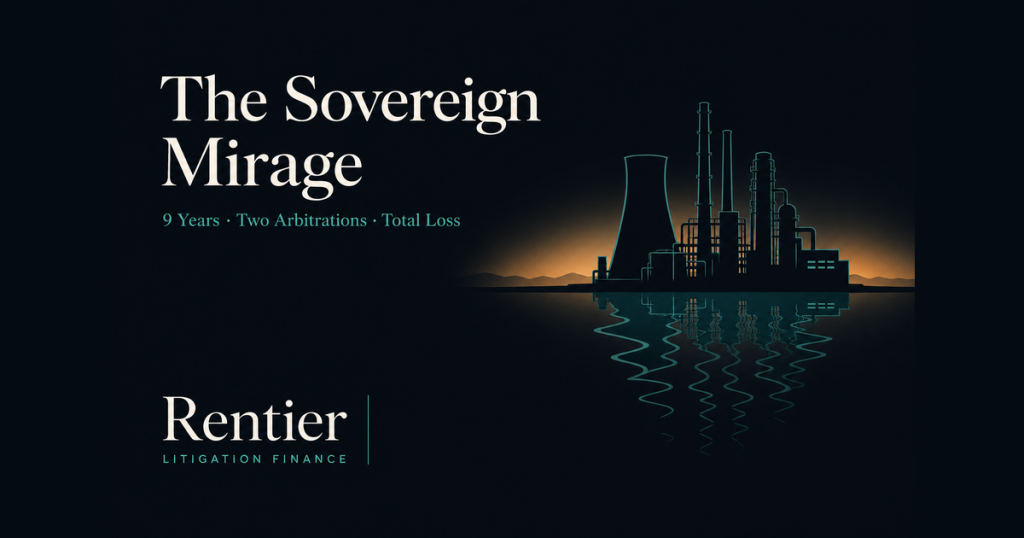
LexShares Case #254: The Sovereign Mirage
A Turkish contractor built $1.5 billion in infrastructure for a Central Asian state. Then the government stopped paying. Two international arbitrations and nine years later — nothing.
The Numbers
| Invested | $50,000 |
| Returned | $0 |
| Net Loss | ($50,000) |
| MOIC | 0.00x |
| IRR | -100% |
| Holding Period | 3,270 days |
The Case
A Turkish construction and energy company completed major industrial projects across a Central Asian state — power plants, refineries, infrastructure. The contracts totaled approximately $1.5 billion in value. The work was done. The facilities were built and operational.
The government didn’t pay.
Across multiple projects, the state withheld retention payments, terminated contracts without cause, and simply refused to pay amounts owed. The contractor claimed $55+ million in damages across three projects:
| Project | Claimed Amount | Issue |
|---|---|---|
| Government ministry (5 facilities) | $15,650,000 | Unpaid 5% retention |
| Oil refinery | €35,000,000 | Wrongful termination + unpaid amounts |
| Power plant | €9,200,000 | Unpaid 5% retention |
The $300,000 fund was structured with counsel on a hybrid contingency fee. The claims were to be filed at the World Bank’s international arbitration tribunal in Washington, D.C., under an investment treaty. On paper, it looked like a strong case — concrete infrastructure built, contracts signed, payments withheld. Sovereign states stiffing contractors isn’t unusual, and investment treaty arbitration exists precisely for situations like this.
What I didn’t fully appreciate: there’s a vast difference between having a valid claim and being able to prosecute it.
The First Arbitration: Wrong Party
In July 2017, two months after my investment, the first case was filed. But there was a problem — and it was fundamental.
They filed under the wrong company.
The holding company — the parent — filed the claim. But the contracts with the government were signed by the operating subsidiary. In investment treaty arbitration, only the party that actually made the investment can bring the claim. A parent company can’t sue on behalf of its subsidiary’s contracts.
The respondent state raised this objection under an expedited procedure. The tribunal agreed, finding the case “manifestly without legal merit” — the harshest possible dismissal. The parent was ordered to pay nearly $1 million in costs. They never paid.
This wasn’t a close call. Filing under the wrong entity is the kind of basic error that makes you question the competence of the legal team. It wasted three years and created a costs liability that would haunt the second attempt.
Four Years of Limbo
After the first dismissal in 2020, the case entered a four-year dead period. Counsel spent years in “dialogue” about whether to refile or sunset the claim entirely. By early 2024, there had been no substantive progress. Then in March 2024, a mysterious third party appeared, allegedly willing to represent the contractor’s subsidiary despite its ongoing bankruptcy proceeding — but counsel couldn’t find any actual new filing at the tribunal.
Finally, in May 2024, a second arbitration was filed — this time under the correct party.
The Second Arbitration: Right Party, No Money
The second case expanded the claims to five projects and over €100 million, adding a gas processing facility and outdoor lighting contract to the original three.
The early signs were cautiously encouraging. Arbitrators were appointed in April 2025. A first session was held. The tribunal set a procedural calendar. The claimant filed its Memorial in July 2025.
But problems were accumulating beneath the surface. The contractor had been bankrupt since November 2016 — before I even invested. No employees, no revenue, no assets except this claim. Everything depended on a third-party funder that had been incorporated with minimal capital and was grossly undersized for an international arbitration against a sovereign state.
Then the claimant admitted in its Memorial that it had lost access to its accounting system. The financial records needed to prove damages were unavailable.
The respondent — pointing to the unpaid ~$1 million costs award from the first case — demanded security for costs. The tribunal ordered the claimant to obtain After-the-Event (ATE) insurance. The policy was approved, but the funder couldn’t pay the premium.
In December 2025, the Tribunal suspended proceedings for three months. The funder never came up with the money.
In April 2026, the Tribunal issued an order discontinuing the proceeding. The case was over.
Timeline
| Date | Event |
|---|---|
| Nov 2016 | Contractor declared bankrupt |
| May 2017 | My investment — $50,000 |
| July 2017 | First arbitration filed — wrong party (the parent company) |
| April 2019 | Incremental funding call to pay tribunal fees and lift stay |
| Aug–Oct 2019 | Respondent files expedited objection; first procedural conference held |
| June 2020 | First arbitration dismissed — “manifestly without legal merit”; ~$1M costs awarded to respondent |
| 2020–2024 | Four years of limbo — counsel debates refiling vs. sunsetting the claim |
| May 2024 | Second arbitration filed — correct party (the subsidiary); claims expanded to €100M+ |
| April 2025 | Arbitrators appointed; first session held; respondent requests security for costs |
| July 2025 | Claimant’s Memorial filed (admits missing key financial records) |
| Oct 2025 | Tribunal orders ATE insurance as security for costs |
| Dec 2025 | Proceedings SUSPENDED — funder failed to pay ATE insurance premium |
| April 2026 | CASE DISCONTINUED |
What the Offering Materials Said vs. What Happened
| Offering Pitch | Reality |
|---|---|
| $55M+ in damages | $0 recovered — no tribunal ever ruled on the merits |
| Completed infrastructure projects | True — but the claimant lost the financial records needed to prove damages |
| Investment treaty protections | Never tested — first case dismissed on standing, second case ran out of money |
| International arbitration (enforceable worldwide) | Moot — no award was ever issued |
| Hybrid contingency counsel | Filed under the wrong entity in the first arbitration |
Warning Signs I Missed
| Red Flag | What It Meant |
|---|---|
| Claimant declared bankrupt before my investment | No financial resources to prosecute the claim; entirely dependent on third-party funding |
| Sovereign defendant | Unlimited legal budget, no settlement pressure, enforcement uncertain even with an award |
| Pre-litigation stage — no case filed yet | I invested before a single filing was made; the legal theory was untested |
| Two-person legal team | A $55M+ sovereign arbitration with a team of two; eventually filed under the wrong entity |
| Complex multi-project, multi-contract structure | Three separate projects, different contract types — proving each claim multiplied the burden |
What I Learned
Sovereign arbitration is not litigation. Suing a company in a US court is different from bringing an investment treaty claim against an authoritarian state at the World Bank. The timelines are measured in decades, not years. Enforcement is uncertain even if you win. And the defendants are sovereign states with unlimited legal budgets funded by natural resource wealth.
The claimant’s financial health matters as much as the merits. The contractor had legitimate claims — $1.5 billion in completed infrastructure, contracts signed, payments withheld. None of that mattered because the entity pursuing the claim was bankrupt and the funder couldn’t cover basic costs like an insurance premium.
Filing under the wrong party isn’t a technicality — it’s malpractice. The first arbitration was dismissed as “manifestly without legal merit” because the parent company filed instead of the subsidiary. This wasted three years, created a costs liability, and emboldened the defense for round two.
Four years of “we’re considering our options” means there are no good options. From 2020 to 2024, the updates were variations on “dialogue with counsel on refiling vs. sunsetting.” That’s four years of a bankrupt claimant trying to find someone willing to fund a case that had already failed once. The eventual refiling didn’t change the fundamental problem.
Nine years of hope is expensive. Beyond the $50,000 in lost capital, there’s the opportunity cost. That money invested in the S&P 500 in May 2017 would have roughly doubled. Instead, I spent nine years receiving sporadic updates about procedural orders, waiting for a resolution that never came.
The Final Score
| Claimed damages (offering) | $55,000,000+ |
| Arbitrations filed | 2 |
| Arbitrations reaching the merits | 0 |
| Years invested | 9 |
| Final recovery | $0 |
This was my 4th LexShares investment and my second-largest loss. A Turkish contractor built $1.5 billion in real infrastructure for a Central Asian government and got stiffed. The first lawyers filed under the wrong company. The second funder couldn’t pay an insurance premium. After nine years, two international arbitrations, and $50,000 of my money, no tribunal ever considered whether the government actually owed anything. The buildings still stand. The money never left.
Commentary and personal experience — not investment, legal, or tax advice. Investing carries risk, including total loss of capital. Always do your own due diligence.