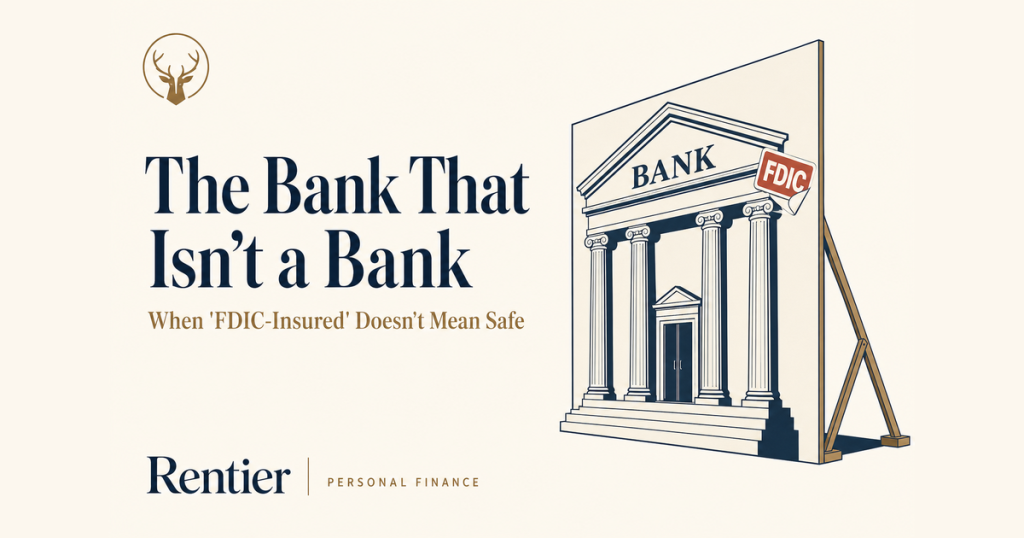
The Bank That Isn’t a Bank: Synapse and the FDIC Mirage
An “FDIC-insured” balance in a fintech app doesn’t mean your money is safe — 100,000+ people learned that when Synapse, the middleware behind their apps, collapsed. Here’s how the trap works, why it’s bigger for the tens of millions chasing “high-yield” apps that aren’t banks, and why the loophole is still wide open in mid-2026.
This one isn’t a deal teardown — it’s about the cash you park between deals, and a comfortable assumption I used to make about it. I was a YieldStreet investor, and I used their Wallet. When the banking-middleware provider Synapse — an Andreessen Horowitz–backed startup, not some fly-by-night operation — collapsed in 2024, I got the emails every affected customer got: distributions delayed, transfers to and from the Wallet frozen, a promise of updates “by Friday.” Then a second wave: your deposits are “securely held at FDIC-insured partner banks,” we’ve done a “cash infusion” to Synapse, we’re working to get you access. Then a third: funds will be returned “in stages,” bank by bank.
I got lucky. I had no cash sitting in the Wallet when the music stopped, so nothing of mine was frozen. That’s it — luck, not diligence. More than 100,000 people at other apps built on the same plumbing were not so lucky, and some of them are still waiting years later. And even my clean escape wasn’t total: a few weeks later I got a fourth letter — Evolve Bank, one of the banks behind the Wallet, had been hit by the LockBit ransomware group, and “it is likely your information is impacted” (name, Social Security number, date of birth). That breach ultimately swept up roughly 18 million people across Evolve’s fintech partners (YieldStreet among them) and settled for $11.9 million — an estimated flat payment of about $20 for each person who bothered to file (the arithmetic only works because barely anyone does), with the claims window already closed. So I dodged the money freeze and still ate the data breach, and the “compensation” for my Social Security number was a $20 coupon I’d have had to file for. That near-miss is why I went and read the whole story, and why I’m writing it up.
A very good recent video making the rounds frames it perfectly — “how millions of Americans got tricked into using a bank that isn’t a bank.” It’s worth ten minutes:
The Through-Line: The Label Is Not the Risk
Regular readers know the one idea this blog keeps circling back to: the label on a financial product is not the risk inside it — read the structure. I learned it the expensive way when a “senior secured” first-lien loan became subordinated scraps in a restructuring. “FDIC-insured” is the same kind of word: reassuring, technically defensible, and quietly conditional. The Synapse mess is the deposit-account version of the exact same lesson.
How the Plumbing Actually Works
Most “fintech” cash accounts — neobanks, savings apps, brokerage cash sweeps, and yes, investment-platform wallets — are not banks. They can’t hold your deposits directly. So the money flows through a chain, and each link in that chain is a place things can break:
| Layer | Who | What they actually do |
|---|---|---|
| The app | Yotta, Juno, YieldStreet Wallet, etc. | The interface you see. Not a bank. Shows you a balance. |
| The middleware | Synapse (banking-as-a-service) | Connects apps to banks and keeps the ledger of who owns what. Not a bank. |
| The bank | Evolve, Lineage, American Bank, AMG | Holds pooled cash in a single “For Benefit Of” (FBO) account. This is the only FDIC-insured link. |
Your money doesn’t sit in an account with your name on it. It sits in one big FBO account at the bank, commingled with everyone else’s, and the record of “$X of this pile belongs to Jordan Reyes” lives on the middleware’s ledger — not the bank’s. That arrangement is fine right up until the ledger and the bank’s books stop agreeing.
Why “FDIC-Insured” Didn’t Save Anyone
Here is the sentence that should be printed on the inside of every fintech user’s eyelids: FDIC insurance pays out when a bank fails. It does not pay out when the app fails, when the middleware fails, or when the ledger is simply wrong.
In the Synapse collapse, no bank failed. Evolve, Lineage, American Bank, and AMG National Trust were all fine. So the FDIC’s insurance fund was never triggered — there was nothing for it to insure against. Yet more than 100,000 people still couldn’t reach their money, because when the bankruptcy trustee (former FDIC Chair Jelena McWilliams, of all people) tried to reconcile the ledgers, the math didn’t add up: end users were owed about $265 million, but the partner banks held only around $180 million against those accounts — an initial hole of roughly $85 million (later pegged at $65–$95 million). The money that was supposed to make each depositor whole wasn’t fully there, and no insurance covers “the middleman’s spreadsheet was off by tens of millions.”
The result was the cruelest kind of fine print made real:
- A customer who deposited ~$130,000 was told the bank had $1,182 in her name.
- A Yotta customer with ~$50,000 recovered $1.49.
- A family that parked ~$280,000 in home-sale proceeds was told they’d get $500.
Even the “Insurance” Is Conditional
The coverage fintechs advertise is pass-through insurance: the idea that FDIC protection “passes through” the FBO account to each underlying customer as if they held the money directly at the bank. It’s real — but it’s not automatic. The FDIC only grants it if three recordkeeping conditions are met, and it only checks at the moment a bank fails:
- The funds are genuinely owned by you, not the fintech.
- The bank’s records show the account is custodial (“FBO”).
- Someone’s records — the bank’s or the middleware’s — accurately tie each dollar to its real owner.
Condition #3 is exactly the thing that broke in Synapse. If the ledger is a mess when the music stops, pass-through coverage can simply fail to attach — and even in a clean case, the FDIC’s own guidance says the pooled deposit then reverts to being insured in the fintech’s name, which can leave you uninsured. Every one of those locked-out depositors had, at some point, looked at a screen with an FDIC logo and felt safe. That’s the crux: “FDIC-insured” is a statement about a good outcome under good conditions — not a vault.
The Bigger Trap: Millions Chasing Yield in Apps That Aren’t Banks
Here’s the part worth being loud about, because a frozen investment wallet is the small version of this problem. The Synapse apps — Yotta, Juno, YieldStreet’s Wallet — were niche. The mass-market version is the tens of millions of ordinary savers who’ve moved their cash into “high-yield” fintech apps chasing a better rate. By 2025, roughly 53 million U.S. adults held accounts at digital-only “banks,” and in 2024 something like 44% of new checking accounts were opened at fintechs and neobanks rather than actual banks. The lure is always the number on the screen: top apps advertise 4–5% APY against a national average bank savings rate of about 0.38%.
Most of those apps are not banks. Chime — the largest, with millions of users — says so in its own SEC filings: “Chime is a technology company, not a bank,” with deposits held at partner banks (The Bancorp Bank and Stride Bank). Chime is a reasonably transparent operator that names its banks — but that’s exactly the point: the structure is identical to Synapse’s. Your safety rests entirely on the partner bank’s records being right and the app staying solvent and honest. The FDIC logo in the app store listing does nothing about either.
When the yield is the whole pitch and the plumbing is opaque, people have lost real money — no bank failure required:
- Beam Financial billed itself as “the first mobile high-interest bank account for the 99%,” dangling rates as high as 7% on “FDIC-insured” deposits with “24/7 access.” Customers then couldn’t withdraw for weeks or months. The FTC sued in 2020 and shut it down in 2021, forcing roughly $2.6 million in refunds and banning the founder from the business. Their deposits were, nominally, in an FDIC-insured bank the whole time — it just didn’t matter, because the app was the thing that broke.
- Voyager marketed rewards up to ~12% and repeatedly told customers their U.S. dollars were FDIC-insured and “safe.” They weren’t: Voyager wasn’t a bank, only its cash at one partner bank (Metropolitan Commercial Bank) was insured — and only if that bank failed — while crypto isn’t FDIC-insured at all. When Voyager went bankrupt in July 2022, customers were locked out; the FDIC and Federal Reserve issued a cease-and-desist over its false FDIC claims, and the FTC later settled with the company and charged its CEO. Fellow crypto-“yield” platform Celsius collapsed the same summer owing customers ~$4.7 billion. Court letters from customers read like obituaries for life savings.
The tell is always the same shape: an eye-catching APY, a slick app, and an FDIC logo doing far more work than it’s entitled to. Above-market yield is payment for risk someone is taking — and if you can’t see where the extra return (or the risk) comes from, the risk is very likely yours. The rate is the bait; the structure is the hook.
“But My High-Yield Account Is at a Real Bank — Am I Exposed?”
Fair question, and the honest answer is: probably not to this. There’s a world of difference between a high-yield app and a high-yield account at a chartered, FDIC-insured bank — and plenty of legitimate online-first and regional banks pay 3.5–4% precisely to win deposits. The rate isn’t the tell; the structure is. If your cash sits directly at a named, chartered bank, FDIC covers you directly if that bank fails — there’s no middleware ledger in between to break, and no “is my slice of the pool documented” question. That’s the good version of this story.
The one question that sorts the safe version from the trap: are you a customer of the bank itself, or of a fintech that merely “provides banking services through” some partner bank? A real chartered bank has its own FDIC certificate you can look up; if the entity you signed up with isn’t that insured bank, go find out which one actually holds your money. Clear that — plus the limit and deposit-product checks in the list below — and a competitive APY is just a bank competing for your deposit, not a red flag.
Where It Stands (as of mid-2026)
| Synapse bankruptcy | April 2024 |
| People locked out | 100,000+ |
| Owed vs. held (June 2024) | ~$265M owed / ~$180M held |
| Estimated shortfall | $65M – $95M |
| CFPB relief allocated (Nov 2025) | $46.2M (~half) |
| Claims process | Not yet open |
| FDIC recordkeeping rule | Proposed; stalled |
More than two years on, the compensation pot the CFPB pulled together — about $46 million from its Civil Penalty Fund — covers only around half the hole, and as of this writing the formal claims process still hadn’t opened. That $46M isn’t a coincidence, either: it’s roughly the gap between the ~$265M owed and the ~$219M the banks eventually paid out, so the CFPB is effectively backfilling the residual hole the banks didn’t cover.
And here’s the wrinkle that should worry anyone counting on that money: the agency writing the check is itself being dismantled. Through 2025 the administration moved to lay off the large majority of the CFPB’s staff and briefly ordered employees to stop work. Historically, the CFPB’s Civil Penalty Fund has taken nearly two years, on average, to go from judgment to first payment — and it’s now trying to do that with a skeleton crew. Recovery for the people actually hurt has been partial, slow, and is coming from a shrinking regulator’s penalty fund, not from deposit insurance.
Is This Fixed? No — and That’s the Point
The tempting read is “Synapse is gone, lesson learned, move on.” Two things say otherwise.
1. The fix isn’t law — and it’s stalling. After the collapse, the FDIC proposed a rule (Recordkeeping for Custodial Accounts) that would force banks to keep daily-reconciled, beneficial-owner records for exactly these accounts. It’s a sensible rule that would have caught the Synapse ledger gap early. But the comment period closed in January 2025, and then the politics turned against it. Under a new deregulatory FDIC board, the agency spent March 2025 rescinding a batch of other Biden-era proposals; a government-wide “regulatory freeze” stalled pending rulemakings; and the fintech industry’s own lobby (the American Fintech Council) has formally asked the FDIC to withdraw this one. It hasn’t been killed — but it hasn’t been finalized either, and the current momentum is toward burying it, not enacting it. The guardrail that would have prevented Synapse is, if anything, further away than it was a year ago.
2. The structure is still everywhere. Synapse died; the model didn’t. The same app-to-middleware-to-pooled-bank stack still sits under a huge share of everyday fintech accounts — and any of them can hit a reconciliation failure, an outage, or a middleware bankruptcy that FDIC insurance was never designed to catch. This wasn’t a freak event; it was a design flaw behaving like one.
The Honest Handicap
Let me be careful about what I’m not saying. My near-miss is not evidence that these apps are safe — if anything it’s survivorship bias with my name on it. And I can’t prove any particular app is mishandling money today; the vast majority process billions of dollars a day without incident, and pass-through insurance genuinely does work when the recordkeeping is clean. The failure here isn’t that fintechs are frauds. It’s that a structure most people believe is bank-grade safe has a specific, well-documented way of failing that the FDIC logo actively obscures. This is a tail risk — low probability, high impact, and almost impossible to hedge once your money is already inside. That’s precisely the kind of risk worth pricing before, not after.
What I’d Actually Do About It
The operational part — the stuff I now do, aimed at anyone who keeps real cash around while hunting for yield:
- Treat a headline APY as a question, not a gift. Above-market yield is someone being paid to take a risk; if you can’t see whose risk it is, assume it’s yours — especially as the rate climbs past ~4–5% into “rewards,” crypto “earn,” or fixed double digits.
- Know the actual bank. Find the named partner bank in the app’s disclosures and verify it exists on the FDIC’s BankFind tool. If you can’t find a specifically named bank, treat that as a red flag, not a rounding error.
- Separate “insured” from “reachable.” Insurance answers “what if the bank fails?” It says nothing about a frozen ledger, an app outage, or a middleware bankruptcy — the things that actually locked people out.
- Mind the aggregation trap. If you already bank directly at the same partner bank behind the app, your balances stack toward the single $250,000 limit at that bank — the split you see in two apps is an illusion.
- Don’t keep operating or emergency cash in a fintech layer. Payroll, rent money, the emergency fund — that belongs somewhere you can reach it on a bad day, not somewhere that can go dark for months while lawyers reconcile a spreadsheet.
- For serious cash, cut out the middleman. Hold it directly at a bank in your own name, or in a brokerage in T-bills / a money-market fund. Give up a few basis points of “high yield” to delete an entire category of counterparty risk.
Where I Land
My YieldStreet book is effectively closed and I don’t put new money there — I wrote up why in detail when they rebranded to Willow Wealth. The Wallet was never a core part of my thesis; it was a convenience I happened not to be using on the wrong day. But the lesson generalizes far past one platform. Every time a screen tells me my money is “FDIC-insured,” I now ask the same question I ask of a “senior secured” note: insured against what, exactly, and who has to fail before that promise does anything for me?
The answer, for a pooled fintech balance, is uncomfortable: the promise only pays if a bank fails, and the thing most likely to separate you from your money isn’t a bank failing at all. So I keep my spending float in apps if it’s convenient, and I keep everything that actually matters one layer closer to the vault. The label said safe. The structure said “it depends.” I’ve stopped trusting the label.
Sources
- YieldStreet investor emails to the author (May 2024 Wallet-delay notices; June 26, 2024 Evolve Bank data-breach notice)
- “How Millions of Americans Got Tricked Into Using a Bank That Isn’t a Bank” (YouTube)
- CNBC: Synapse trustee says $85 million of customer savings is missing (Jun 7, 2024) — 100,000+ customers; ~$265M owed vs ~$180M held
- American Banker: Evolve Bank says it will start returning money to Synapse end users — ~$65M–$95M shortfall; McWilliams as trustee
- U.S. Senate Banking Committee letter re: Evolve (Apr 22, 2025) — individual loss examples
- American Banker: CFPB to refund $46 million to Synapse victims; CFPB Civil Penalty Fund — $46,248,291 allocated Nov 28, 2025
- Fintech Business Weekly: The Synapse-Evolve Disaster, One Year Later — ~$265M owed vs ~$219M paid; residual ~$46M gap
- Federal News Network: CFPB can proceed with mass layoffs (Aug 2025)
- FDIC: Recordkeeping for Custodial Accounts (RIN 3064-AG07) — proposed rule; comment period closed Jan 16, 2025; not finalized
- Steptoe: FDIC Board rolls back several Biden-era rulemaking actions (Mar 3, 2025); American Fintech Council letter requesting withdrawal
- FDIC: pass-through deposit insurance requirements
- American Banker: Evolve Bank settles for $11.9 million over 2024 data breach — LockBit; ~18 million people; YieldStreet among affected fintechs
- FTC: Mobile banking app Beam settles allegations it misled users about access to funds and interest rates (2021) — high-yield savings app, ~$2.6M refunds, founder banned
- FDIC & Federal Reserve: cease-and-desist to Voyager Digital over false FDIC-insurance claims (Jul 2022); FTC settlement with Voyager (Oct 2023)
- Neobank scale: ~53.7M U.S. adults on digital-only accounts by 2025 (EMARKETER/Insider Intelligence); Chime FY2025 Form 10-K (“Chime is a technology company, not a bank”)
Commentary and personal experience — not investment, legal, or tax advice. Investing carries risk, including total loss of capital. Always do your own due diligence.