The Prohibition Model: North Carolina Bans Litigation Funding
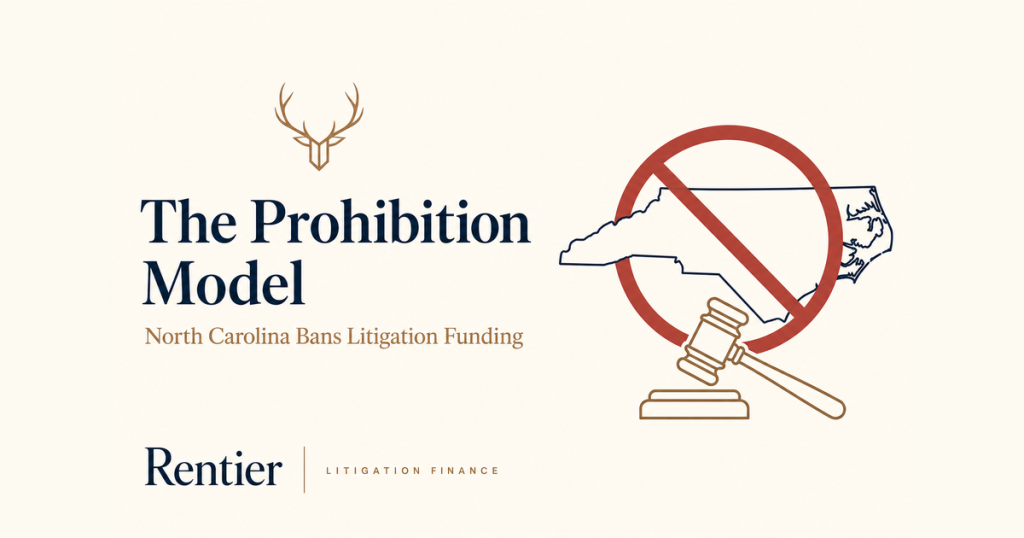
On June 22, 2026, North Carolina became the first US state to ban third-party litigation funding outright — not disclosure, not a cap, a flat prohibition. Here’s what the statute actually does, and what it means for the asset class.
The Headline
Most states fighting over litigation finance have landed on disclosure — make funders register, reveal the agreement, bar them from controlling strategy. Kansas, Michigan, and others passed versions of that this year. North Carolina just did something categorically different: it banned the practice.
Governor Josh Stein signed House Bill 315 — the Prohibit Litigation Investments Act — into law on June 22, 2026 (Session Law 2026-14), effective immediately. It passed the House unanimously and cleared the Senate 45-1. The bill was championed by the North Carolina Chamber and backed by the U.S. Chamber’s Institute for Legal Reform.
| Statute | HB 315 / SL 2026-14 (GS Ch. 66, Art. 52) |
| Signed | June 22, 2026 (effective immediately) |
| Model | Prohibition — not disclosure |
| House vote | Unanimous |
| Senate vote | 45-1 |
| Civil penalty | Up to $50,000 per violation (AG-enforced) |
| Private remedy | Treble the contemplated investment |
What the Statute Actually Does
The operative language (GS 66-514) makes it unlawful to “engage in litigation investment in this State or to furnish litigation investment to a party or counsel of record in a civil proceeding in this State.” “Litigation investment” is defined as providing money for the fees, costs, or expenses of a pending or potential civil proceeding in return for compensation contingent on the outcome.
Two things matter about that trigger:
- The hook is the North Carolina proceeding — not where the funder is located. A New York or London funder backing an NC-venued case is in scope.
- It reaches both the party and “counsel of record.” That sweeps in portfolio facilities extended to law firms, not just single-case deals with a plaintiff.
The Teeth
This isn’t a registration form with a late fee. The enforcement structure is aggressive:
| Mechanism | Effect |
|---|---|
| Contract voided (GS 66-515) | The offending funding agreement is unenforceable |
| AG civil penalty | Up to $50,000 per violation; AG may seek injunctions |
| Private right of action | Injured parties recover statutory damages of treble the contemplated investment |
| Long-arm jurisdiction | Funder is “purposefully availed” and subject to suit in NC “whether they have transacted business in the State or not” |
That last row is the one funders should reread. The statute reaches out and asserts personal jurisdiction over an out-of-state funder solely because it financed an NC case — and instructs courts to construe the Act liberally to effect its purpose.
The Carve-Outs Don’t Help Commercial Funders
The Act exempts a few things, but none of them shelter the commercial model:
- Pro bono and nonprofit legal aid funding
- An insurer’s defense or indemnification obligations
- Loans or financial support not contingent on the outcome of the proceeding
Outcome-contingent return is the entire commercial funding model. A non-recourse advance that gets repaid only on a win — whether it’s a single commercial case or a portfolio facility — is exactly what the statute prohibits. The carve-outs describe everything litigation finance isn’t.
Who Is Actually Affected?
Here’s the nuance the headlines miss: the direct, near-term hit to most large commercial funders is probably modest.
The high-value commercial disputes that anchor a serious funder’s book — antitrust, patent, breach of contract, international arbitration — venue overwhelmingly in Delaware, the Southern District of New York, the big federal dockets, and arbitral seats. North Carolina state court is not where this capital concentrates. So NC-specific deal flow is a small slice of a typical commercial portfolio, and the number of contracts directly voided on day one is likely small.
That’s the reassuring read. The exposure that actually bites is more subtle:
| Exposure vector | Why it matters |
|---|---|
| Active / pipeline NC-venued matters | Any agreement financing an NC case is now at risk of being unenforceable |
| Portfolio facilities that touch NC cases | The “counsel of record” language can reach a multi-case facility even if the funder never set foot in NC; expect explicit NC carve-outs in new facilities |
| Consumer / pre-settlement funders | More NC retail exposure than commercial funders, and no transparency-regime middle ground to fall back on |
| The precedent | This is a template other states can copy — the real risk |
The Real Story Is Precedent Risk
The reason this matters beyond North Carolina is that it breaks the pattern. Every other state that “regulated” litigation finance this cycle picked the disclosure lane — annoying for funders, but survivable, and arguably even helpful for legitimizing the asset class. North Carolina picked prohibition, and it did so with a near-unanimous, bipartisan vote and a well-funded Chamber coalition behind it.
That combination — a clean legislative template plus a demonstrated path to passage — is exactly what makes copycats likely. Industry coverage was blunt about it: the question isn’t whether NC’s own ban reshapes the market (it won’t, on its own), it’s whether a handful of states follow. If three or four states adopt prohibition models, that’s a structural repricing of the asset class — venue risk becomes a first-order underwriting input, not a footnote.
Three Open Questions That Set the Magnitude
How much this actually costs the industry depends on questions the statute doesn’t cleanly answer — and that will get litigated:
| Question | Why it’s unresolved |
|---|---|
| Retroactivity | Does “voids any contract in violation” reach pre-existing agreements on in-flight NC cases, or only new ones? Retroactive voiding invites Contracts Clause and due-process challenges. |
| Federal reach | Can a state statute govern funding of cases in NC federal courts? There’s a credible Erie / preemption argument that it can’t fully — which would leave a federal-diversity lane partly open. |
| Constitutionality | The aggressive long-arm provision raises dormant-Commerce-Clause and extraterritoriality concerns. Expect the funding industry to look for a test case. |
What This Means for Retail-Adjacent Litigation Finance
I spend most of my time on this blog dissecting the retail end of litigation finance — the crowdfunding platforms that let individuals buy slices of funded cases. So the natural question is: does a venue-specific ban matter to a small investor in a diversified pool of cases?
Indirectly, yes — through two channels:
- Deal supply. Retail platforms already struggle with adverse selection — the best cases get funded by sophisticated capital before they ever reach a crowdfunding portal. A prohibition trend that pushes funders to screen out entire states narrows the funnel further and complicates portfolio construction.
- The regulatory signal. Prohibition (vs. disclosure) reflects a political judgment that the activity itself is illegitimate, not just opaque. That framing — “litigation as a market for financial investment” is something to stop — is the kind of narrative that, if it spreads, raises the tail risk on every litigation finance position, retail or institutional.
None of this changes the core lesson I keep relearning: in litigation finance, the structural and procedural risks — standing, collectability, enforcement, and now venue legality — routinely matter more than the merits of the underlying claim. North Carolina just added a new line item to that list.
Where I Land
- The direct impact is small; the precedent is the point. NC isn’t a core venue for commercial funding, so the day-one balance-sheet hit is limited. The thing to watch is the copycat count.
- Prohibition is a worse outcome for the industry than disclosure. Disclosure regimes, however irritating, implicitly accept the asset class. A ban says the activity shouldn’t exist. That’s a more dangerous template precisely because it’s cleaner to copy.
- Venue is now an underwriting input. Expect funding agreements and portfolio facilities to start carving out prohibition states explicitly, and expect a constitutional test case before long.
For now, North Carolina stands alone. The question the whole industry is sitting with is whether “first” turns out to mean “only” — or “first of many.”
Sources
- North Carolina HB 315, Prohibit Litigation Investments Act, Session Law 2026-14 (enacted June 22, 2026; codified at GS Chapter 66, Article 52)
- Office of Gov. Josh Stein, “Governor Stein Takes Action on Six Bills” (June 22, 2026)
- UNC School of Government, Legislative Reporting Service — HB 315 bill summary
- “North Carolina bans third-party litigation funding,” Business Insurance (June 2026)
- “North Carolina’s Litigation Funding Ban Could Spur Other States to Similar Action,” Law.com / The American Lawyer (June 25, 2026)
- North Carolina Chamber, “North Carolina Becomes First State in the Nation to Ban Third-Party Litigation Investment” (June 22, 2026)
This post is analysis and commentary, not legal or investment advice. The characterization of exposure vectors and open legal questions is my own opinion, not a statement of settled law.
Last updated: June 2026