LexShares Case #617: The $5 Million They Should Have Taken
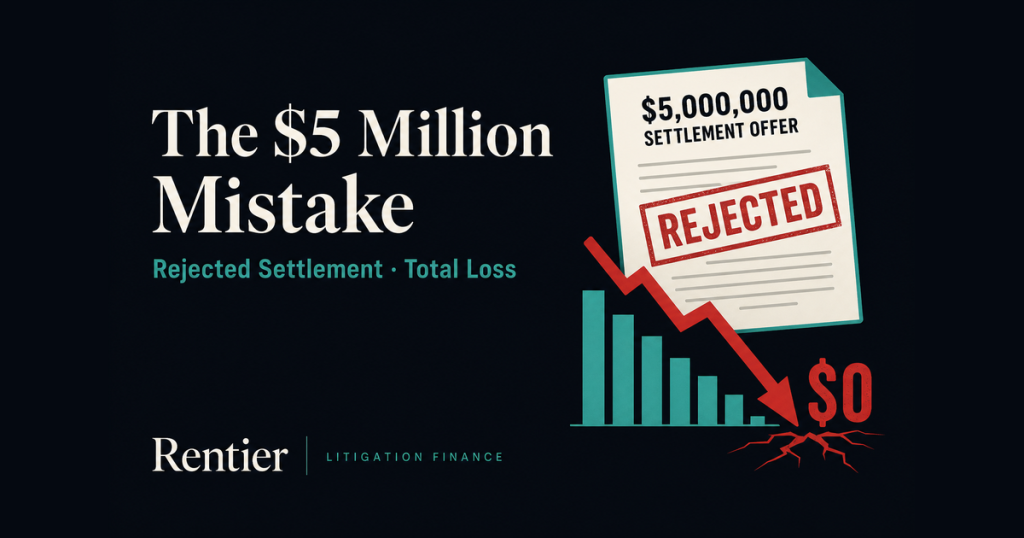
A retail developer rejected a $5M settlement offer, went to trial, lost, appealed, lost again. Total loss.
The Numbers
| Invested | $82,500 |
| Returned | $0 |
| Net Loss | ($82,500) |
| MOIC | 0.00x |
| IRR | -100% |
| Holding Period | 1,351 days |
The Case
In 2009, a major metropolitan transit authority — one of the nation’s largest, with 120+ million annual riders — issued a request for qualifications seeking a retail vendor to establish outlets across its 40+ stations.
A California-based retail development company responded. In June 2013, they signed a lease option agreement to develop a coordinated retail plan across approximately 70,000 square feet of station space.
The vision was ambitious:
- Retail kiosks throughout the transit system
- A concierge system with a custom app
- Technology-forward shopping experience for commuters
- New revenue stream for the transit authority without fare increases
The developer invested considerable time, expense, and energy pursuing the project. Then, according to their complaint, the transit authority allegedly reneged on its promises:
- Unreasonably withheld design approvals
- Failed to establish the agreed-upon design review committee
- Consistently failed to provide timely feedback
- Caused the project to fail
The developer filed suit in March 2017, seeking $100+ million in damages — including costs expended and tens of millions in lost profits.
The $5 Million Offer
On March 30, 2018, the transit authority submitted a $5 million Section 998 settlement offer.
The plaintiff rejected it.
Under California’s Section 998, if a plaintiff rejects a settlement offer and then fails to obtain a more favorable judgment at trial, they can be liable for the defendant’s post-offer costs. It’s designed to encourage reasonable settlements.
The plaintiff believed their case was worth more than $5 million. They were wrong.
Timeline
| Date | Event |
|---|---|
| Jun 2013 | Lease option agreement signed |
| Mar 2017 | Initial complaint filed |
| Mar 2018 | $5M settlement offer — rejected |
| May 2018 | Demurrer overruled — case proceeds |
| Sep 2018 | LexShares offering funded — my investment $82,500 |
| Aug 2019 | 5-week jury trial begins |
| Sep 2019 | Verdict for defendant |
| May 2020 | Appeal filed |
| Nov 2020 | Opening appellate brief filed |
| Apr 2022 | Oral argument at appeals court |
| Jun 2022 | Appeal denied — judgment affirmed |
What Went Wrong
The jury didn’t buy it. After a 5-week trial with complex legal issues and many witnesses, the jury returned a verdict for the defendant. The transit authority convinced them that they hadn’t breached the agreement — or that the plaintiff couldn’t prove damages.
The appeal failed. The plaintiff appealed, filed briefs, requested oral argument, and lost. The appellate court affirmed the lower court’s judgment. No further appeals. Disposition final.
Government defendant fought to the end. Public transit authorities have in-house counsel and no profit motive to settle quickly. They’ll defend aggressively when they believe they’re right — especially against $100M+ claims.
$100M+ claimed damages were speculative. Lost profits from a retail program that never launched, across 40+ stations, over a multi-year timeline — that’s a lot of projection. Juries are skeptical of speculative damages.
Jury dynamics worked against the plaintiff. The plaintiff — an Asian-American woman — was asking a local jury to award $100M+ against their own transit system. Even in a diverse city, implicit biases can affect how jurors perceive plaintiffs seeking large damages from public institutions. Whether consciously or not, jurors may be less inclined to hand a massive verdict to someone who doesn’t look like “one of them” — especially when the money comes from local taxpayers.
The rejected settlement haunts this case. $5 million was on the table in March 2018 — six months before LexShares even funded the case. The plaintiff rejected it, went to trial, and got $0. Every investor would have been better off if the plaintiff had taken the deal.
The Math That Could Have Been
| Scenario | My Return |
|---|---|
| Actual outcome (trial + appeal loss) | $0 |
| If $5M settlement accepted (est.) | ~$115,000* |
*Rough estimate assuming 2x return on $2.5M funding, 30% carry, my 3.3% ownership share
The irony: by the time LexShares funded this case, the $5M settlement had already been rejected. I knew about the rejection when I invested — it was disclosed in the offering materials. I saw it as a signal of confidence. Rejecting $5M to chase $100M+? They must believe in their case. In hindsight, they were wrong — and so was I for reading it that way.
Warning Signs I Missed
| Red Flag | What It Meant |
|---|---|
| $100M+ claimed damages | Highly speculative — project never launched |
| Government/public entity defendant | Will fight aggressively, no settlement pressure |
| $5M settlement rejected before offering | I read it as confidence; in hindsight, overconfidence chasing $100M |
| Complex “failure to cooperate” theory | Harder to prove than clear-cut breaches |
| Plaintiff demographics vs. jury pool | Asian-American plaintiff seeking $100M from local institution; implicit bias risk |
What I Learned
Rejected settlements can look like confidence. When I invested, the plaintiff had already rejected $5M. I thought: “They must have a strong case to turn that down.” In reality, they were chasing $100M+ and ended up with nothing. A rejected settlement isn’t always strength — sometimes it’s hubris.
Government defendants don’t fold. Public entities have salaried lawyers, taxpayer backing, and no pressure to settle nuisance claims. If they believe they’re right, they’ll fight through trial and appeals.
Jury demographics matter more than we admit. An Asian-American plaintiff asking a local jury for $100M+ against their transit system faces headwinds that don’t show up in case documents. Implicit biases — who jurors instinctively sympathize with, who they see as “deserving” — can quietly tip verdicts. It’s uncomfortable to acknowledge, but it’s real.
Speculative damages rarely survive trial. Lost profits from a never-launched retail program across 40+ stations is a lot of assumption. Juries want concrete numbers, not projections based on what might have been.
Trials are binary events. Five weeks of testimony, complex issues, many witnesses — and then it comes down to a jury verdict. Win or lose. The plaintiff lost.
Appeals rarely reverse trial verdicts. The plaintiff appealed, briefed, argued, and lost again. Appellate courts defer to jury findings of fact. If you lost at trial, you’ll probably lose on appeal.
The Final Score
| Claimed damages | $100,000,000+ |
| Settlement offer rejected | $5,000,000 |
| Jury verdict | $0 (defendant wins) |
| Appeal outcome | Affirmed |
| Final recovery | $0 |
This was my 11th LexShares investment. The plaintiff had rejected a $5 million settlement offer before the case even came to LexShares. I saw that as confidence — they must believe they’ll win big. After a 5-week trial, a jury verdict for the defendant, and a failed appeal, they got nothing. I got nothing. Sometimes the biggest lesson is knowing when to take the deal.
Commentary and personal experience — not investment, legal, or tax advice. Investing carries risk, including total loss of capital. Always do your own due diligence.